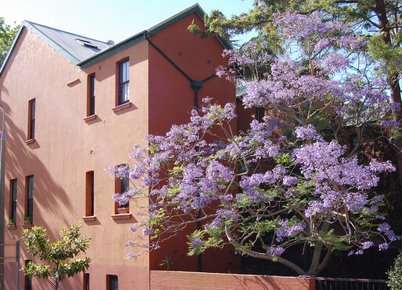
Saturday, December 03, 2005

Weekend Art

Mitjili Napurrula

latest art addition - thank you Jesper.


Thursday, December 01, 2005

Edmund Burk lost in localism


P.P. McGuinness makes sense about the rise of nimbyism in our electorates and laments the departure from Edmund Burke's approach to government and representation.

"a modern version of one of the oldest dilemmas of democratic politics: whether the elected member is to act in the manner Edmund Burke insisted on, as true representative of the electors and acting in accordance with his own judgment of their, and the national, interest; or whether to be simply a mindless delegate whose job is to vote according to their instructions and self-perceived interests without exercising independent judgment."


P. P. McGuinness: The Australian
The rise of localism

The parish-pump politician who kicked Baywatch off a local beach represents a growing trend: the triumph of nimbyism, the not in my backyard syndrome

CONVENTIONAL wisdom in the press describes electoral outcomes such as the result in last Saturday's by-election in the NSW seat of Pittwater in Sydney as a punishment of the political party that normally holds it. In this case, however, the result indicates a far more profound shift in our voting patterns. It is the triumph of localism and parish-pump politics over the wider concerns of federal or state politics.This has been an emerging and increasingly serious trend in the motivations of voters during recent years. It is not just that electorates are tending to vote more and more for independents on account of their personal qualities and popularity. Even though these attributes may be useful, far more important for a growing section of the electorate is that a local representative should be seen to be placing themselves at the direct service of their electorate and locality, placing its interests and concerns above those of the wider polity and community.
That is, the trend represents the triumph of nimbyism, the not in my back yard syndrome. For it is not just a matter of advancing one's own local interests but of defending them to the exclusion of the interests of the wider community, or simply narrow-minded selfishness.
Thus, while the filming of episodes of Baywatch on Avalon beach hardly represents a great contribution to the welfare of the nation (although considerations of overseas tourism should not be forgotten), the opposition to this led by Alex McTaggart, the newly elected member for Pittwater, was what kicked off his political trajectory. This was a purely selfish response: it's our beach and how dare anyone who doesn't live around here get any benefit from it or interfere in any way with our enjoyment of it.
This is only a particular example of the nonsense that goes on all the time in local government politics when roads are closed or narrowed to close off "rat runs", a derogatory term for the use of minor roads as alternative links between trunk roads. The residents are claiming that the roads belong to them and no one else.
The same is true of insistence that development of multiple dwellings in spaces hitherto occupied by single-family houses ought to be prevented: "there are enough people here already".
An aspect of this is the intention also to preserve the use of local roads for existing residents only. The standard complaint about any new development is that it will create traffic and parking problems for those who got there first.
It is but one form of the phenomenon noted years ago by John Paterson, an outstanding analyst of the economics of urban planning. He pointed out that the steady rise in required standards of housing was one of the chief means by which the relatively rich excluded lower income groups from "their" suburbs.
Far from being embarrassed by such manifestations of selfishness, they are asserted more and more vociferously, with a resulting pressure on the standards of political life and representation to fall. If an important qualification for being a lower house parliamentarian is to have lived in a particular electorate and been involved in its local affairs for years, then the opportunities for highly qualified and able people to find a place will be greatly limited. Yet one of the reasons most often given by those normally Liberal voters who this time voted for McTaggart was that the Liberal candidate was not a local; indeed, he was barely known in the electorate.
It may be considered that such a preference at least limits the power of the party machines; we saw what happened in the NSW south coast electorate of Cunningham in 2002 when an unpopular head office candidate of no distinction was parachuted in to contest a by-election for Labor. An unknown local Green was elected.
There was considerable local discontent at the parachuting of Peter Garrett into the Sydney federal electorate of Kingsford Smith last year, which was muffled by the context of an imminent election with a new, apparently promising, Labor leader.
It is usually at by-elections that discontent with the established parties is manifested by the election of independent locals, often to be reversed at a general election. But the growing number of local heroes serving as independents even after a general election shows that a more fundamental force is operating. The supra-local parties are being challenged by the local activists and interest groups.
This partly accounts for the growing influence of the Greens in the inner-city electorates. While some of their vote comes from ideologically committed supporters, more of it is local support as a result of their unhesitant embracing of all the local nimby causes. The Greens, like other nimbies, are purely cynical in their campaigning regardless of merit on local issues. And many nominal Labor supporters in these areas are far more interested in local concerns, such as traffic, parking, parks, dog facilities and suchlike than in any traditional left-wing causes.
In effect, the voters everywhere are becoming more and more like the traditional supporters of the Nationals. Country Party politics - that is, the politics of cynical self-advantage, of pork-barrelling and local advantage at the expense of the national interest - is becoming a more general model. This kind of thing is typified by the behaviour of senator Barnaby "Bjelke-Petersen" Joyce, who quite shamelessly declares that he answers only to his own voters, in his own state, and is prepared to sell his vote for the highest return to them he can extract. Many of the local heroes regard him with envy because of his strategic position.
This is a modern version of one of the oldest dilemmas of democratic politics: whether the elected member is to act in the manner Edmund Burke insisted on, as true representative of the electors and acting in accordance with his own judgment of their, and the national, interest; or whether to be simply a mindless delegate whose job is to vote according to their instructions and self-perceived interests without exercising independent judgment.
Increasingly the demand today is that the member should be a combination of welfare worker, lobbyist, ombudsman and friend and servant to local interests.
Ability and knowledge of the world, or any special expertise, are discounted more and more. No longer can we imagine a Bert Evatt or a Garfield Barwick, coming from the highest levels of the law, stepping into parliament and serving their country. They would not, these days, find a local seat. All the places are reserved for local heroes or party hacks imposed on the locals or cluttering up the Senate benches. Even the occasional, unusual, parachuted drop-in, such as Garrett, is recruited not because of any apparent ability but in the hope of garnering more votes from the ignorant or winning back a few Green votes.
The reality is that the Pittwater result has little to do with Liberal factionalism (much exaggerated in the media). It has a lot to do with the victory of nimbyism over serious policy considerations and good government.
P. P. McGuinness is the editor of Quadrant magazine.

Wednesday, November 30, 2005

Keep the Liberal flame alive


A great Australian and a great Liberal laments the conservative take-over of the modern Liberal party and determines to stay in the party to support those who maintain that liberalism is the political philosophy best expressed to appeal to the aspirations of all Australians whilst building a compassionate, understanding and accepting society. (See eCouncillor earlier blog on an Australian Bill of Rights launched by Fraser at Sydney Town Hall).

Picture SMH - She won't be right Â… Malcolm Fraser yesterday.Photo: Jesse Marlow
Why I thought of quitting Libs

By Michael Gordon and Louise DodsonNovember 30, 2005

MALCOLM FRASER has considered quitting the Liberal Party after more than 50 years' membership, saying it has become "a party of fear and reaction".
The former prime minister said last night he had decided to remain a member to support those who were seeking to "keep the Liberal flame alive" and to encourage others to pursue change from within.
Delivering the chancellor's human rights lecture at the University of Melbourne, Mr Fraser said he found his party "unrecognisable as liberal" and alien to the principles of its founder, Robert Menzies. On the night the Government's anti-terrorist laws passed the House of Representatives, Mr Fraser singled them out, saying the legislation was wrong because "it makes the fundamental assumption that liberty cannot defend itself".
"The reason I considered [resignation] seriously is because I believe this is not just another piece of policy with which one doesn't agree," he said.
"Over several years there has been a fundamental departure from the basic idea of liberalism as I understood it. What I want to do is emphasise in the strongest possible way how serious this is, how people should not just let it fly over the shoulder and say 'She'll be right'."
Insisting it would be a long, hard task to achieve change, Mr Fraser said: "It might not be the next government. It might be the government after that. But there ought to be objectives to restore basic liberties and restore a true sense of the rule of law."
Mr Fraser joined the Liberal Party in the early 1950s. In the lecture, he said the Government's handling of the Tampa episode in 2001 marked "the effective end of the liberal age and the beginning of the period of regression".
The Government had failed to make a case for the new terrorism laws and any claim to be taken on trust had been destroyed, Mr Fraser said.
"The fact that the Government, with the support of the Opposition, has moved so far away from the rule of law demonstrates the fragility of our grasp of a liberal, democratic society," he said. "If we stand silent in the face of discrimination and in violation of the basic principles of humanity, then we betray our way of life."
Read more here.

Desal cash for Council


SMH Spike column considers Council's decision yesterday to lease part of the former Woolworths building opposite Town Hall to one of the two bidders for Sydney's controversial desalination plant (see Malcolm Turnbull's speech on sustainability blogged here earlier). They ask - hypocrisy or acting economic responsibly? I voted for the later.

Fields of Clover
TALK about having your salted cake and eating it too.
The Lord Mayor, Clover Moore, and most of her merry band of City of Sydney councillors resolved in August that they were "strongly opposed" to Morris Dilemma's de-salting water factory.
Council minutes show the declaratory motion was put up by the Liberal councillor Shayne Mallard and supported by Moore's Village People and the Greens councillor, Chris Harris. The three Labor councillors opposed it. Cut to yesterday's extraordinary council meeting. The same council voted, with only Harris opposing, to lease part of its Woolworths building at Town Hall to a group bidding to build the desalination plant.
Freshwater Alliance got its new offices for a undisclosed, seven-figure sum. We guess that makes the council more economic realists than hypocrites.

spike@smh.com.au Spikeline: 9282 2080 Fax: 9282 3253

Tuesday, November 29, 2005

Senate safeguards Freedom of Speech


Liberal Senator Marise Payne has chaired a senate inquiry into the Federal governments proposed anti-terror laws and focused on the controversial sedition laws. Whilst the Senate may be in the control of the government any Senate inquiry that delivers bi-partisan recommendations would be ignored at the government's peril. The report below from today's Telegraph accurately covers the issue.

Sedition law threat to freedom
By MALCOLM FARR
November 29, 2005
LIBERAL senators told the Federal Government yesterday its controversial re-write of sedition laws should be scrapped.
They joined Labor in urging the proposals be sent to a review by the Australian Law Reform Commission.
Existing laws covering treason and incitement to violence could be used while the laws were being reviewed.
The senators, members of a committee inquiring into anti-terror laws, also said the Government should review other measures every five years, rather than 10 as planned.
Those measures included preventative detention without charge or trial, and control orders limiting movement.
The Government wants the provisions contained in its Anti-Terrorism Bill passed into law before Christmas.
It had originally allowed for only a one-day Senate inquiry but granted a week after political pressure.
The committee chair, Liberal Marise Payne, said it had received 300 submissions during the brief inquiry and the overwhelming bulk had shown concern about the "updated" sedition laws.
There were claims they could be used to prevent journalists covering security issues, smother legitimate dissent, and censor the arts.
Senator Payne said Attorney-General Philip Ruddock had promised a review of the laws after they were passed. The committee recommended the review be held before the provisions were enacted.
"Given the significant concerns about the sedition provisions raised by a broad range of organisations, the committee as a whole considered that it was inappropriate to enact legislation which is considered in need of review," Senator Payne said.
"The committee has recommended that the sedition provisions be removed from the Bill in its entirety, pending a full and independent review by the Australian Law Reform Commission."
The committee generally endorsed the increased powers for ASIO and law enforcement agencies, but wanted tighter monitoring of their application.
It recommended the Ombudsman play a more significant role, and the laws would lapse after five years, when they would be reviewed, rather than the 10 years the Government wanted.
The committee said "measures proposed in the Bill are extraordinary in nature and it is appropriate that the responsible minister report regularly to the Parliament, and that there be an independent review of the operation in their entirety and a report to Parliament after five years".
It also urged that minors be separated from adults when in detention; the removal of restrictions on the role of lawyers of people under preventative detention; supplying reasons why a person has been detained; and a right for detainees to make representations before being detained.

Friday, November 25, 2005

Sydney falls behind Melbourne yet again! and Cyclists demonstrate their Rights to our Streets

From the Melbourne Herald Sun news that 'Copenhagen' style bike lanes are being proposed. IE bike lanes where physical barriers are placed between bike lanes and traffic - unlike the CCT bike lanes blogged earlier.

http://www.heraldsun.news.com.au/printpage/0,5481,17308681,00.html

Euro-style plan for bicycle city John Ferguson 21nov05

BICYCLE super-stations and key changes to traffic flows are part of a controversial $10 million plan to bring European-style commuting to Melbourne.Riders will be able to park, shower and even drink coffee at cafes attached to several major bike stations dotted across the city.
Melbourne City Council is also backing sweeping changes to bike paths to make commuting safer.
Councillor Peter Clarke wants expanded a push to create Copenhagen-style bike paths into the CBD.
These paths involve placing physical barriers between riders and motor vehicles.
Parked cars can be shifted further into the roadway to enable bikes to travel protected, next to the gutter.
This option will alter traffic flows in some areas, with the trade-off being increased safety to riders and pedestrians.
Cr Clarke said a key part of his vision involved building several bike super-stations where riders could shower, store their bike and even drink coffee.
Areas that could be used for the super-stations include the Docklands, the vaults under Federation Square, the city baths and in the parliamentary precinct.
"You could have a proper shower, treat these places like a small lounge," Cr Clarke said.
He said the strategy -- which would require initial funding of $2 million a year -- was not anti-car.
"Far from it. It's not about impeding vehicles, it's about providing a viable alternative," Cr Clarke said.
Thousands of cyclists commute to the city each day but rising numbers of motor vehicles throughout Melbourne are making the trips increasingly perilous.
The City of Melbourne has already supported a limited trial of a safer bike path, between Melbourne University and RMIT.
But Cr Clarke has outlined up to 12 major bike routes into the city that he believes need further attention.
St Kilda Rd is one of the key roads that feeds cyclists into the streets of the CBD.
He described commuting along Flinders St as being particularly dangerous for cyclists.
Lord Mayor John So is also backing the new deal for cyclists, saying the idea of super-stations was gleaned from Copenhagen.
Cr So said that cycling was an essential part of the council's transport strategy.
The council was eager to considerably increase bicycle use in the city.
"I don't see why the Copenhagen model can't be adopted in Melbourne," he said.
In Copenhagen, visitors or residents are also able to take part in a free bike exchange where they pay a small price to borrow a bike, with the fee refunded when the bike is returned.
Bicycle Victoria's Sean Pinan said for a relatively small investment, commuters could be encouraged to ride if the facilities were user-friendly.
BV has backed the use of the Government's controversial congestion tax to help pay for the $15 million it believes is needed to implement a rider-friendly strategy for the CBD.
Cr Clarke said the tax had made no difference to city congestion.
"This is about dealing with the problem, not taxing people," he said.


Meanwhile tonight on Park Street outside Town Hall hundreds of cyclists stretching from George ST to Hyde Park demonstrated their determination to be seen and heard on our roads as equal users. I arrived out front too late to get a good picture of the two wheeled mass but did witness the empty STA bus that tried to push through the cyclists and was abruptly halted by the cyclist police shown.

Earlier in the day I walked with the Lord Mayor through the CBD to a meeting and we spotted a law abiding cycle courier with the extended long frame and rack that allows him to compete with motor vehicle bookings. I pointed out to the Lord Mayor that the cyclist courier represented one less courier van or truck running around the CBD and clogging up the cities arteries and damaging the envoronment. A very CBD sustainable alternative. With the World Bike Courier Championships in Sydney late next year and over 300 international competitors and their supporters converging on Sydney and Olympic Park in heated couirer competitions, I have asked Council to sponsor the traditional welcome breakfast at the home of bike couriers - Martin Place and to work with the bike couriers to encourage responsible riding in our city. We can then move on to the motorised couriers, taxi and bus drivers.


Labor's Environmental White Elephant

A day at various business functions and meetings in Sydney has left me with no doubt that the Labor Iemma/Carr government has lost the plot by going ahead with the desalination project to meet Sydney's water crisis. The announcement this morning (see SMH) was a spin doctors attempt to blunt the sharp edges of PPP's following the Cross City Tunnel fiasco. With a $1 billion buy back price tag on the dud tunnel and penalties for establishing competing services - including public transport corridors, the public and business sectors are rightly distrusting of the Labor government's ability to deliver a cost effective PPP or hybrid PPP as we have been presented.

Whilst the Labor government seems to have removed the excessive annual payments to the private sector that Malcolm Turnbull MP referred to in his speech on the Sustainable Cities report (read it on my blog here), it now suddenly requires $1.3 billion of taxpayers capital investment! That's $60 on every household water bill each year and only to meet about 10% of Sydney's water needs. Water recycling and storm water harvesting are the only way ahead. But they required planning at least 5 years ago and it's all too late for Morris Iemma who needs a quick fix to win the next election and who has been handed the poison chalice by Carr. For as the great expanse of Sydney's traditional green Kikuyu and couch lawns whither away and the sound of summer sprinklers become stories passed on by grandfathers, the reality of Labor's poor planning is biting home. And no razzle dazzle desalination plant is going to deflect the growing suburban anger. And this from a government who lectures the Howard team on not signing Kyoto....

Untapped resource ... stormwater swirls from an ocean pipe at Dover Heights. Soon ocean water will be turned into drinking water further down the coast.Photo: Peter Rae SMH on line


Sydney Morning Herald's Editorial Column
Taking the easy option
November 24, 2005

The heavens are mocking Sydney's proposed desalination plant. As the Premier, Morris Iemma, announced the $1.3 billion project, heavy showers were sweeping past his offices in Governor Macquarie Tower. It was a timely reminder that historically Sydney has not been short of rain. The city is short of water because it wastes it. Sydney needs a long-term plan for recycling waste water and storm water. Desalination remains the quick fix; finding water to waste instead of saving the water we have.

The desalination plant is another hand-me-down from former premier Bob Carr that Mr Iemma has uncritically embraced as the easy thing to do. It puts Sydney in the absurd position of spending $1.3 billion on a desalination plant it must pray it will never need. It is no surprise that it will be financed by the State Government; no private organisation would take on such a ludicrous endeavour. And the question must be whether the public should take it on either. After becoming Premier, Mr Iemma should have cast fresh eyes over such a bleak financial prospect. What could $1.3 billion otherwise provide in water-saving incentives to households and industry; or new infrastructure; or wholesale recycling of the water Sydney dumps in the ocean? We do not know the options because the Government hasn't bothered to do the sums. So much for fiscal responsibility from the man who is not only Premier, but Treasurer.

Sydney's modest consolation is that the plant at Kurnell might have cost more. The Government has opted for a relatively small plant producing 125 megalitres of drinking water a day, enough to supply 350,000 people, instead of up to $2.5 billion for a plant to supply a third of Sydney's needs. Though government-owned, the plant will be built and operated by private industry and the hapless water users will foot the bill. The Government says that will be about $1.20 a week each for the 1.6 million households served by Sydney Water. Read more.

Related coverage
Buckets of money down the drain
Part-time plant a waste
This time take a close look at the fine print
By Anne Davies, Wendy Frew and Matthew MooreNovember 24, 2005

Sydney's planned desalination plant will be smaller than expected and funded by taxpayers not the private sector, after the NSW Government decided it needed more flexibility on operating the energy-intensive plant.
The Premier, Morris Iemma, announced yesterday the Government would commission the smallest plant on its drawing board - one capable of producing 125 megalitres a day - at a cost of up to $1.3 billion.
Sydney Water will look at increasing water prices to help pay for it - an extra $1.20 a week on the average bill, Mr Iemma said.
"This will make us less reliant on rain for our water supply," he said. "It will also be our insurance policy, when the next drought occurs or if this drought persists."
The plant at Kurnell will still be built by the private sector and operated and maintained by one of the water companies that tendered for the project.
The Utilities Minister, Carl Scully, said a 125-megalitre plant would meet 9 per cent of Sydney's daily needs. However, the Government has retained the option of building a plant capable of producing 500 megalitres a day.
Mr Scully said the estimated cost of the 500-megalitre plant was $2.5 billion, not $2 billion as previously stated.
The Government says the decision to keep the plant gives it much-needed flexibility. "When the dam levels are full obviously we won't operate the plant," Mr Scully said.
He said the Government would have been obliged to compensate a private operator if the plant was not in use.
However, some water experts suggest turning a reverse osmosis desalination plant on and off might not be straightforward. "It can be done, but the membranes have to be 'pickled' with a preserving solution," said Greg Leslie, associate professor at the University of NSW's centre for membrane science.
Read more.

Wednesday, November 23, 2005

Council needs a role in Protecting Privacy

The SMH reports that private video camera surveillance systems are being set up by Sydney-siders to spy on and even intimidate their neighbours. In his report to Parliament the acting privacy Commissioner John Dickie has highlighted to proliferation of cameras in the private domain and the lack of ability those affected by them have for legal recourse and protection.
Mr Dickie said many complaints involved multiple cameras, including one incident in which a household set up six cameras to spy on the neighbouring property. The commissioner's annual report, tabled in Parliament last week, said the practice had increased but police and councils were had no remedy for such complaints."The activity seems to fall between the cracks of existing laws," the report said. "It is an area of disputation which ought not be allowed to continue without some recourse being available."

It's not clear if Councils have the ability to protect privacy in these circumstances. As a Councillor I have previously expressed concerns about private CCTV installed over the public domain - often a requirement of a development consent. Walk along many Sydney streets and private cameras will film you from hotel and club awnings and convenience store doorways often streaming back to unknown control rooms or recorders. I acknowledge the legitimate security role these cameras play and the assistance they often provide to Police investigating crimes. However their installation and management should be subject to conditions or protocols that protect privacy and guarantee the responsible management of the images and any feed.


We have already seen images of actors in brawls or women in revealing fashions offered for sale to the media and on the internet. There is growing community concern about the filming of children and juvenile's for inappropriate purposes. A number of inner city apartment blocks have adopted the growing trend to install CCTV within building common areas (eg carparks, doorways, rubbish areas and halls) and feed the live images back to all occupants in the building via their television sets. The developers claim that this allows every resident to be an unpaid security guard. Attractive as this may seem on face value - to think that a building busy-body is sitting in their lounge room watching your every move is at least disturbing.

Council's network of cameras covering much of the CBD are protected by a strict set of protocols that can be adapted for other camera systems. With regard to cameras installed in the private domain and filming neighbours, I suspect a legitimate need to apply for a Development Consent and will ask Council at the next meeting to investigate and report how we can better regulate the proliferation of private cameras to safeguard privacy. People affected by the potential intrusion of cameras have a right to object and a level of protection. If Council's are powerless to regulate CCTV then parliament needs to consider an amendment to the planning laws.
Read more

Tuesday, November 22, 2005

The Failed Exit Strategy


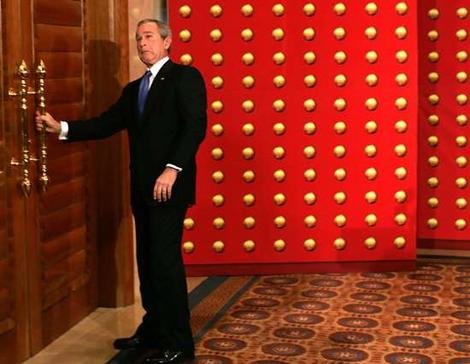
From Town Hall meetings to world politics. I thought the quote from George Bush in today's press very powerful. The picture accompanying it of the President exiting a press conference only to discover the door locked is quite amusing and had to give rise to the inevitable 'exit strategy' captions.

"Free people did not falter in the Cold War, and free people will not falter in the war on terror. Like the ideology of communism, the ideology of Islamic radicalism is destined to fail - because the will to power is no match for the universal desire to live in freedom." President Bush in Mongolia.

Picture above: "Failed exit strategy ... George Bush finds himself in a spot of bother as he pulls on a locked door while trying to leave a news conference in Beijing" Photo: AP /SMH

Bush praises Mongolian hordes for revisiting Iraq
November 22, 2005
George Bush yesterday became the first US president to visit Mongolia, thanking the heirs of Genghis Khan for sending troops to join his "war against terror".
Mr Bush stopped in the bitterly cold Mongolian capital, Ulan Bator, for four hours on his way home from an Asian tour that has taken him to Japan, South Korea and China.
In a speech to Mongolian leaders and members of parliament at the central government building, Mr Bush said Mongolians had stood with Americans as "brothers in the cause of freedom". The nation of 2.8 million mostly nomadic people has sent 160 soldiers to Iraq - the first Mongolian soldiers in the country since a son of Genghis Khan sacked Baghdad in 1258 and slaughtered most of its Muslim population. The number is small but White House officials pointed out to reporters that, per capita, only two other countries - Britain and Denmark - had sent more of their soldiers to Iraq.
Read more.


Monday, November 21, 2005

Redfern Oval proposal is a Win Win


Public debate on the future of Redfern Oval has taken many twists and turns over the past 5 years since the former South Sydney City Council initiated a task force to consider its future. In one team is the Rabbitohs patriarch and saviour George Piggins and leading the other team is defender of the parklands Clover Moore. There have been many speeches and heated public meetings and tonight's Council meeting will (or should) adopt a position for the Council staff to start the master planning for the redevelopment with some certainty. Council's report recommends that the Oval be upgraded to a first class training facility for Souths and the Juniors with a capacity of 8,000 spectators including a modern small stadium approximately to the size of the existing obsolete grand stand. The grand stand is to include appropriate facilities such as change rooms. The Souths position is a stadium capable of 1st grade games all season.

Most eCouncillor readers will be aware of the historic links the Souths Rugby League club has had with the Redfern Oval ground going back over half a century. Souths historically emerged from the oppressive over-crowded working class suburbs of Redfern Waterloo to become one of the great teams of League's classic era. George Piggins and his supporters seem intent on recapturing that lost glory by returning to Redfern Oval with various proposals for a ground capable of NRL 1st grade games. But the park, facilities and neighbourhood are just not capable of sustaining a permanent home for 1st grade games with facilities needed for over 20,000 spectators. The fair argument is also made that with the modern Aussie Stadium less than 2km away at Moore Park, Souths can train at Redfern Oval and play home games at Aussie retaining a close tie to their deep community roots that extend well beyong the immediate Redfern Waterloo community.

I support the Council proposal as a way forward but believe that Souths should have the ability to play a few 'heritage' matches at Redfern Oval each season. These would be the games expected to draw smaller crowds and be subject to a strict DA process to manage issues such as crowd control and traffic impacts. To facilitate this and the Koori Cup weekend the ground perimeter will need to be fenced. This can be done with hired temporary fencing as we see around the city regularly. However I am not opposed to an appropriately designed permanent perimeter fencing so long as large openings are in place on each side and the gates are open and closed each day by the Council. In fact as the report recommends the whole ground must remain in the control of the Council and not licensed to Souths as has been the historical situation.

Last week's Council Committee considered a proposal by the PCYC to have a youth club relocated from the nearby public housing estate to the base of the grandstand. This proposal was opposed by the Clover Moore councillors but I agreed that it warranted further investigation. There are some terrific synergies with community partnerships and League player mentoring that appear evident in this proposal. However a preliminary investigation by Council staff has recommended against the proposal based on significantly increased costs and the nearly 4 times larger grand stand needed to accommodate the club. The whole issue has spilled over into the State parliament with the local ALP member attacking Clover Moore (the MP for Bligh). I noted my Liberal colleague the gallant Barry O'Farrell riding in to Clover's defence.

Tonight's debate promises to be a historical moment for South and Piggins.

STOP PRESS

The following amendments proposed by me were adopted at the Council meeting. They leave open the opportunity for perimeter fencing that will satisfy Souths and South's Juniors playing some games on Redfern Oval.

Amendment to 8.2

add to (iii) after 'training ground'

(iii) Provision of facilities to allow the use of the ground as Souths NRL football club preferred training ground and subject to Plan of Management and Development Application processes, a ground for a limited number of preseason training or exhibition matches.

(ix) remove Cr McInerney additional amendment and replace with:

'investigate the possibility of new perimeter fencing of artistic and functional merit and designed by competition reflecting the Rabbitohs cultural and sporting connection to Redfern Oval. Such commemorative fencing will be as unobtrusive as possible and incorporate large retractable openings at gates and other points on the perimeter. The day to day operation and management of the gates and openings is to remain in Council's control.'

Moved Councillor Mallard


Sunday, November 20, 2005

Weekend Pics - Sculpture by the Sea

A late visit to a seasonal favourite the 'Sculpture by the Sea' exhibition was in time to hear Malcolm Turnbull announce this year's people's choice award Michael Purdy's time and space (facial deconstruction) 2005. The SMH today discusses the work pictured below.


Denise Hume - refuge


Jarrod taylor - structural wave (in background of refuge)


Ben Resch 'the great aussie surf trip'
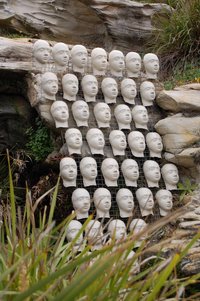

Verna Truninger - messengers

Tuesday, November 15, 2005

CCT bike lanes Not Safe


My thanks to Fiona in the bicycle community for her tireless work on improving cycling facilities and safety on Sydney streets. This is the eastern portal the CCT and is also what has been approved for Oxford Street and William Street upgrades. For information the bike lanes are shared with the bike friendly buses.

"The attached photo is of the "bike lane" on Craigend Street, Rushcutters Bay. Is this as good as it gets for bikes in a $680 million project? The RTA Project Manager responsible for this should be made to ride in it daily, perhaps. Then his successor would be motivated to get it right.

The bus stops appear to require the use of the bike lane. Is this how it is supposed to be? Could there be a site meeting to work out what needs to be done to make the bike lanes usable, let alone something that will encourage cycling?

Someone cynical might put it to the RTA Project Manager that in trying to maximise the number of car trips through the tunnel for the RTA's financial gain, he is not supposed to be toying with people's lives. Please would you help us resolve what is surely a completely unsatisfactory result.
"

Always listen to the Fine Print

Spike today takes a closer look at Clover Moore's promise to donate her salary to charity. It appears that the 'cat's out of the bag' and the Lord Mayor has been holding back the Councillor allowance component of her package - about $25,000 per annum or $100,000 over the term of Council. Whilst the decision to create a trust and donate her Mayoral allowance is to be acknowledged as generous - it was in fact forced upon her when the 'two jobs' issue was becoming a negative in her run for the mayoral chains. The donation is a political decision and many people see it as inappropriate that Council resources are used to promote the charity trust in Council publications and media releases.

Fields of Clover
By Joel Gibson and Tim DickNovember 15, 2005

Illustration: Rocco Fazzari see great cartoon here

The term "per cent" is an adverb meaning "in every hundred", so 100 per cent equals everything, as in: all, the lot, the entire historical cast of Neighbours, including Mrs Mangle.
During last year's election campaign, Clover Moore pledged to gift her salary to charity should she win the lord mayoralty. Her website now proclaims: "I receive a salary as a NSW Member of Parliament, and donate 100% of the Lord Mayor's fees for charitable purposes through this Trust."
But 100 per cent of her civic fees is not given to charity. The mayoral salary has two parts: the basic "annual fee" paid to all city councillors ($25,850) and an "additional fee" for the lord mayor ($141,900).
A slice of the second fee goes to her deputy, and the rest goes to the trust. In addition to $110,650 she gets as an MP, she pockets $25,850, meaning she actually donates 83.17 per cent of what she gets from the council.
Was her claim misleading? Hell no, according to Clover, who told us the legislation clearly distinguishes between councillor and mayoral fees, and asked if we weren't missing the point: she is donating half a million dollars to charity over this term. Well, maybe, suppose so. She says she gets no tax benefit for it, either.

Green madness at Waverley

The Greens on Waverley Council have lost the plot with their illogical attack on one of Australia's great cultural traditions and rights - the backyard pool. The article below from today's Sydney Morning Herald demonstrates how irrational the Greens have become. The Greens want backyard pools banned to save water - yet Sydney Water says pools use on 2% of the water used by Sydney homes. 'This compares with 15% flushed down the toilet and 17% in washing machines.' Will the Greens be advocating a ban on toilet flushing and washing clothes soon? What's behind this madness is a barely disguised disdain for conspicuous consumerism and wealth. The photograph below from the SMH illustrates the investments households make in the backyard pools. It is often said the Greens are 'water melons - green on the outside and red inside' and with some antecedents in the communist movements this is an example of that anti-capital mantra bubbling to the surface. It took the Waverley Labor Councillors a very long time to disassociate from the Green motion. I expect it will be defeated at tonight's meeting and remembered at the next election.


Waverley residents defend their pools
By Bonnie Malkin and Richard MaceyNovember 15, 2005

Laps of luxury Â… backyard pools abound in the beachfront suburb of Dover Heights.Photo: Robert Pearce
Related coverage
Idea: stop flushing millions of dollars down the toilet
Waverley Council will press ahead with plans to vote on banning swimming pools, lap pools and plunge pools tonight despite widespread criticism.
The swimming pool industry and home owners have called on the council to withdraw the motion to prohibit new pools, but Waverley's Mayor, Mora Main, said the council still wanted to discuss the issue.
"The debate has been quite good. It has caused a bit of a riot and has challenged traditional Aussie values about the backyard, but it's nice to see people thinking about water," she said.
Cr Main said she and fellow Greens councillor George Copeland want to investigate banning pools to save water.
But the president of the Swimming Pool and Spa Association of NSW, Manfred Wiesemes, said residential pools accounted for less than 10 per cent of the annual household water used in greater Sydney.
"When a pool is filled with water it can remain full for 10 years or more. They do need a bit of extra water from time to time but the majority of that is added by rain," he said.
The highest concentration of pools in Sydney was in the eastern and northern suburbs, such as Ku-ring-gai and Lane Cove, he said.
The president of the Local Government Association, Genia McCaffery, said motion's intention was good but it was better to assess each pool individually.
The motion comes a day after the Bureau of Meteorology said this year would be the hottest year since records began in 1910.
Read more here.

Sunday, November 13, 2005

Weekend Pics - Spanish festival & Jacarandahs


Sydney's November garden show is on.
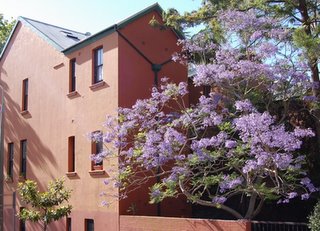
Jacarandah on Challis Avenue Potts Point

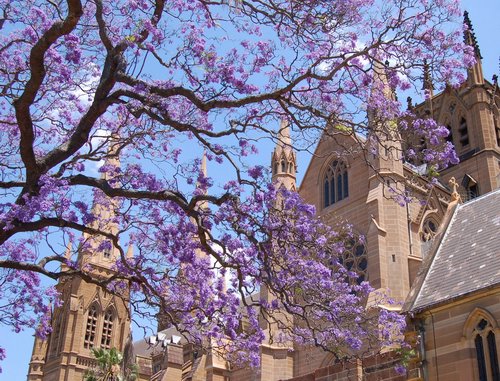
St Marys cathedral

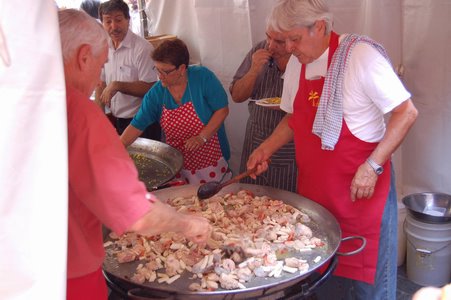
Sunday's Spanish Festival in the 'Latin Quarter' of town (between St Andrews cathedral and China Town. Lots of people out for a fun day with food, sangria and entertainment.

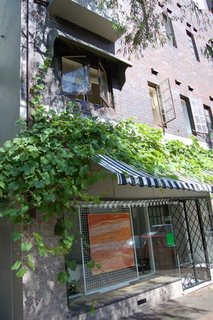
Love grape vines for softening buildings.