Monday, March 20, 2006
Human Rights and Water Canons
eCouncillor is a well known supporter of a Human Rights Bill for Australia. (Read post on launch of campaign at Town Hall http://ecouncillor.blogspot.com/2005/10/launch-of-campaign-for-human-rights.html )
A charter of rights for NSW seems (reported in today's SMH and below) a step in the right direction balanced with the news on the same day that the government is to purchase water canons for Police to manage football riots. Using water canons seems like resignation to managing the issues giving rise to football riots and other riots like Cronulla, Redfern and Macquarie Fields. As the anger rises and riot violence escalates will the politicians be forced to escalate the responses with tear gas and South African apartheid era armoured troop carries? The government needs to invest real resources in identifying the underlying causes for social unrest and get in there to address them before explosive riots. We certainly do not want to be confronted with violent civil unrest as bedevils France.
Charter of rights plan to be put to cabinet
By Jonathan PearlmanMarch 20, 2006
THE NSW Attorney-General, Bob Debus, has declared his support for a charter of rights for the state that would allow courts to consider whether laws infringed basic human freedoms.
Mr Debus told the Herald he would take a proposal to cabinet to invite public consultation on the values and rights Parliament should protect.
It could guarantee freedoms such as the vote, a fair trial, freedom of assembly, property rights and freedom from torture and racial discrimination.
The charter - similar to those in Victoria, the ACT, Britain and New Zealand - could also bind government agencies, including the police service, over their treatment of employees and the public.
Mr Debus said a charter would not go as far as constitutional bills of rights, such as those in the US and Canada, allow courts to declare laws invalid.
Instead, Parliament would be required to ensure laws complied with the charter and provide human rights impact statements. If the courts believed basic freedoms were infringed, they could declare laws were incompatible with the charter and send them back for review. This would not bind Parliament when reconsidering any legislation.
Mr Debus said the terrorist threat had forced the Government to pass "extraordinary laws", and this prompted the need to declare the values and rights that Parliament should protect.
The charter would enshrine fundamental freedoms and ensure the Government protected human rights, while responding to terrorist threats, he said.
"The times we live in are causing us to pass some laws that intrude on traditional freedoms in ways that we have not experienced in recent times.
"I support our laws on terrorism as they have been drafted - and the community does too - but they potentially restrict freedoms. This is a process by which the whole community discusses what it thinks are our basic values and tells the Parliament that it wants them protected."
Mr Debus said a charter could promote tolerance in the wake of the Cronulla riots. "A charter would hopefully help to remind the community that all people in a society have equal rights," he said.
Australia is the only common law country without a bill to protect human rights, prompting the ACT and Victoria to develop their own bills.
The federal Attorney-General, Philip Ruddock, has criticised Victoria's plan to introduce a charter, saying it would create a "lawyers' feast" and transfer power to unelected judges.
But a constitutional expert, Professor George Williams, who helped draft Victoria's charter, said a similar bill introduced in Britain in 1998 had resulted in almost no increases in litigation.
"It is about improving government and preventing human rights problems," he said. "When you look at recent events in Sydney, there is obviously a strong need for education about our democracy and the values we need to adhere to."
The former premier Bob Carr strongly opposed a bill of rights, saying it transferred too much power to the courts and would lead to litigation concerning "naked strollers" and "vegetarian menus".
However, Mr Debus said the process would "not merely be the property of civil liberty activists".
A similar consultation process in Victoria under a committee chaired by Professor Williams attracted more than 2500 public submissions.


Monday, March 13, 2006
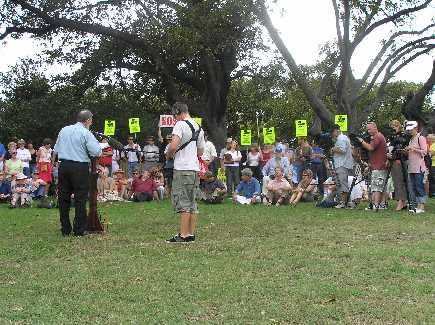
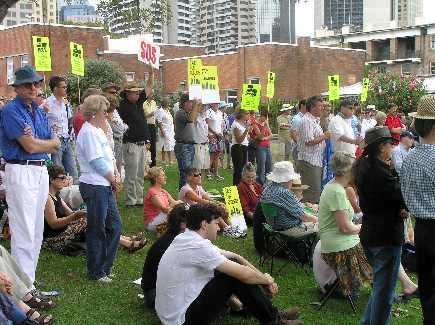
Weekend Rally to save Sydney's working harbour

A small but enthusiastic crowd turned out to protest against the State Labor Government's short sighted sale of the working harbour foreshore assets around Darling Harbour. I was pleased to lead a team of local Liberals (pictured) as we heard speakers from many walks of like including Barry O'Keefe, President of the National Trust, green Bans veteran Tom Uren and John Coombes from the Maritime Workers Union who criticised the Labor government's shortsighted agenda. To make the government sit up and listen to this protest will require more support from the community.
See blogs below for state Liberal Party Position.
*
Friday, March 10, 2006
Rally to Save Sydney's Working Harbour
Save Sydney Harbour will be officially launched on Saturday 11th March 2006
A public rally will be held at Observatory Hill starting at 11am.
Speakers will include Tom Uren, Robert Coombs and Phil Jenkyn.
Make sure your voice is heard on this important day of action.
"We want to support a working harbour in Sydney. It's a part of life of Sydney. The plans the government have put forward simply don't add up."- John Brogden
Sydney Town Hall Forum Wednesday 24 August 2005 - John Brogden
"We want to support a working harbour in Sydney. It's a part of life of Sydney. The plans the government have put forward simply don't add up."- John Brogden
Thank you Judge, Councillors, to my fellow panelists, Comrade Coombes, to those who've taken time out of your evening to be here. Firstly may I apologise for being late - I got caught up in Sydney's traffic on the way down.
I guess the proposition I start from is that there's not a person alive who can remember Sydney as anything other than a working harbour. This is not a proposition that we have to restore Sydney to what it was ten, twenty, thirty, forty, fifty years ago. In fact if anything the capacities of Sydney to be a working harbour have diminished in recent times. On a personal note, as somebody who was born in Balmain and lived there till I was five, whose grandmother has lived in Balmain all her life, and spent a couple of my teenage years living in Balmain, the sounds of the Harbour, the sounds of the working harbour, are part of the life of Sydney. So, in one sense this is not seeking to eliminate an intrusive, disruptive new development - this is a case of keeping in place part of the character of Sydney.
This was a decision made by the former Premier, therefore with a change of leadership in the government the new Labor leader actually has an opportunity to reverse the decision that has no personal embarrassment to him. I don't wish to make a political point or political tack in this, it's actually an opportunity, and I'm sure Clover would agree, for the current Premier to make a statement that he disagrees with the previous Premier on this issue. It's actually an opportunity, ladies and gentlemen, for the working harbour policies of the year 2000 to be restored and maintained into the future. I'd encourage Maurice Iemma to do exactly that. I'd encourage him to say "this was a decision of my predecessor with which I strongly disagree" and restore the policy to its original position. That opportunity exists and it's an easy thing for him to do. He won't in fact be criticized - he'll be praised.
In terms of the position that I take to this, I from the initial announcement of the policy by Bob Carr was unable to make sense of why this actually needed to happen. So the first question is "What is the motivation. Why reduce the capacity of the working harbour?" If it is nothing other than to send more opportunity, more business, more development, more jobs north and south of Sydney in to the other ports then in that sense I think it is short-sighted. If, as Clover says, this is a policy of sending over 100,000 vehicles to Wollongong, only to have half of them come back to Sydney on a road structure that is completely unable to cope with that, and on a rail line equally unable to cope, then that will not benefit the people of the Illawarra. In fact it will be a curse for them in terms of the lack of infrastructure investment. If it's a policy about changing the character of Sydney Harbour for the better, then he ought to scrap it because I don't see the benefit. The character of Sydney Harbour is a character that is appropriate, that is long-standing and that is universally welcomed and received. If it's a policy about turning over the foreshores for housing, and for private ownership and private development, well I can only but echo the comments of Tom Uren - why do we have to go through this fight all over again and why should we be turning the foreshores of Sydney, more of the foreshores, over to unprecedented private development? Yes, we'll get the sweet at the end of the meal that will return walkway or some parkland to the fringes of Sydney but it will change the character of Sydney and reduce the public open space and in my view reduce the quality of life for the Sydney we see here today.
We want to support a working harbour in Sydney. It's a part of life of Sydney. The plans the government have put forward simply don't add up. If this is about the government pleasing significant development interests, and I think that's very short-sighted as well, I'd have to say now with a change of status in the government I don't know if it will be the former Lord Mayor, the Minister for Planning Frank Sartor responsible, whether it will be Michael Costa or whether it will be Maurice Iemma himself. It's not clear yet and Clover I don't know whether you've got a clear view on who is now responsible for this process, this programme (Clover: I think it's Frank Sartor). Right - that will be an enjoyable meeting of you and him- we should sell tickets to raise money - I'd prefer to be on your side!
If it's Frank Sartor, then that's disappointing because it will be regarded as a political fight and a "get square" rather than planning for the future of Sydney. Our position is that it will damage the shipping industry, it will damage employment opportunities; if there is a capacity to expand port facilities, particularly in Wollongong and Port Kembla, then they should be for the overflow from Sydney. On the advice I've received, some eighty percent of the cargo that comes in to Sydney goes no further than 40 km from Sydney Harbour. Why make it go 120 km? Why actually add to the problems and Sydney's traffic problems, and Greater Sydney's traffic problems even further?
So our commitment is to work with you for a working harbour, happy to look at opportunities for the overflow and for the growth of exports and imports in to Sydney and Port Kembla. I don't think anyone here is asking for an expansion of Sydney as a working harbour but for a sensible maintenance of Sydney as a working harbour.
As somebody who was born in the inner city, grew up in the parts of the inner city and who's family is closely associated with the working shores of Balmain, as far as I'm concerned the city we have is the city we love; it's a city we can live in because we want to be here, and I do encourage in a genuine sense Maurice Iemma to take the opportunity that is now afforded to him by the fact that he is now the new Premier and that the old Premier made the decision, to reverse this and to maintain the policies of the working harbour.
I congratulate the Trust and the organizers for bringing this together. I think it is an important public meeting and I indicate very clearly that I am pleased to work on a continuing basis with the Coalition and with the Trust and the Sydney City Council and with other parties to ensure that we can have a fighting coalition if you like on this issue.
*
A public rally will be held at Observatory Hill starting at 11am.
Speakers will include Tom Uren, Robert Coombs and Phil Jenkyn.
Make sure your voice is heard on this important day of action.
"We want to support a working harbour in Sydney. It's a part of life of Sydney. The plans the government have put forward simply don't add up."- John Brogden
Sydney Town Hall Forum Wednesday 24 August 2005 - John Brogden
"We want to support a working harbour in Sydney. It's a part of life of Sydney. The plans the government have put forward simply don't add up."- John Brogden
Thank you Judge, Councillors, to my fellow panelists, Comrade Coombes, to those who've taken time out of your evening to be here. Firstly may I apologise for being late - I got caught up in Sydney's traffic on the way down.
I guess the proposition I start from is that there's not a person alive who can remember Sydney as anything other than a working harbour. This is not a proposition that we have to restore Sydney to what it was ten, twenty, thirty, forty, fifty years ago. In fact if anything the capacities of Sydney to be a working harbour have diminished in recent times. On a personal note, as somebody who was born in Balmain and lived there till I was five, whose grandmother has lived in Balmain all her life, and spent a couple of my teenage years living in Balmain, the sounds of the Harbour, the sounds of the working harbour, are part of the life of Sydney. So, in one sense this is not seeking to eliminate an intrusive, disruptive new development - this is a case of keeping in place part of the character of Sydney.
This was a decision made by the former Premier, therefore with a change of leadership in the government the new Labor leader actually has an opportunity to reverse the decision that has no personal embarrassment to him. I don't wish to make a political point or political tack in this, it's actually an opportunity, and I'm sure Clover would agree, for the current Premier to make a statement that he disagrees with the previous Premier on this issue. It's actually an opportunity, ladies and gentlemen, for the working harbour policies of the year 2000 to be restored and maintained into the future. I'd encourage Maurice Iemma to do exactly that. I'd encourage him to say "this was a decision of my predecessor with which I strongly disagree" and restore the policy to its original position. That opportunity exists and it's an easy thing for him to do. He won't in fact be criticized - he'll be praised.
In terms of the position that I take to this, I from the initial announcement of the policy by Bob Carr was unable to make sense of why this actually needed to happen. So the first question is "What is the motivation. Why reduce the capacity of the working harbour?" If it is nothing other than to send more opportunity, more business, more development, more jobs north and south of Sydney in to the other ports then in that sense I think it is short-sighted. If, as Clover says, this is a policy of sending over 100,000 vehicles to Wollongong, only to have half of them come back to Sydney on a road structure that is completely unable to cope with that, and on a rail line equally unable to cope, then that will not benefit the people of the Illawarra. In fact it will be a curse for them in terms of the lack of infrastructure investment. If it's a policy about changing the character of Sydney Harbour for the better, then he ought to scrap it because I don't see the benefit. The character of Sydney Harbour is a character that is appropriate, that is long-standing and that is universally welcomed and received. If it's a policy about turning over the foreshores for housing, and for private ownership and private development, well I can only but echo the comments of Tom Uren - why do we have to go through this fight all over again and why should we be turning the foreshores of Sydney, more of the foreshores, over to unprecedented private development? Yes, we'll get the sweet at the end of the meal that will return walkway or some parkland to the fringes of Sydney but it will change the character of Sydney and reduce the public open space and in my view reduce the quality of life for the Sydney we see here today.
We want to support a working harbour in Sydney. It's a part of life of Sydney. The plans the government have put forward simply don't add up. If this is about the government pleasing significant development interests, and I think that's very short-sighted as well, I'd have to say now with a change of status in the government I don't know if it will be the former Lord Mayor, the Minister for Planning Frank Sartor responsible, whether it will be Michael Costa or whether it will be Maurice Iemma himself. It's not clear yet and Clover I don't know whether you've got a clear view on who is now responsible for this process, this programme (Clover: I think it's Frank Sartor). Right - that will be an enjoyable meeting of you and him- we should sell tickets to raise money - I'd prefer to be on your side!
If it's Frank Sartor, then that's disappointing because it will be regarded as a political fight and a "get square" rather than planning for the future of Sydney. Our position is that it will damage the shipping industry, it will damage employment opportunities; if there is a capacity to expand port facilities, particularly in Wollongong and Port Kembla, then they should be for the overflow from Sydney. On the advice I've received, some eighty percent of the cargo that comes in to Sydney goes no further than 40 km from Sydney Harbour. Why make it go 120 km? Why actually add to the problems and Sydney's traffic problems, and Greater Sydney's traffic problems even further?
So our commitment is to work with you for a working harbour, happy to look at opportunities for the overflow and for the growth of exports and imports in to Sydney and Port Kembla. I don't think anyone here is asking for an expansion of Sydney as a working harbour but for a sensible maintenance of Sydney as a working harbour.
As somebody who was born in the inner city, grew up in the parts of the inner city and who's family is closely associated with the working shores of Balmain, as far as I'm concerned the city we have is the city we love; it's a city we can live in because we want to be here, and I do encourage in a genuine sense Maurice Iemma to take the opportunity that is now afforded to him by the fact that he is now the new Premier and that the old Premier made the decision, to reverse this and to maintain the policies of the working harbour.
I congratulate the Trust and the organizers for bringing this together. I think it is an important public meeting and I indicate very clearly that I am pleased to work on a continuing basis with the Coalition and with the Trust and the Sydney City Council and with other parties to ensure that we can have a fighting coalition if you like on this issue.
*
Harry Seidler leaves a great legacy for Sydney
I was saddened to hear of Harry Seidler's death yesterday. At age 82 it is a great tribute to his work that even today his buildings are being constructed around the town including Council's own $40 million Ian Thorpe Aquatic Centre on Harris Street Ultimo and just down from Town Hall on George Street the Meriton Tower half finished but showing it's signature sensual Seidler curves. I think Harry is one of Australia's greatest architects and he has certainly left his mark for a century to come. When I moved to East Sydney more than a decade ago controversy was flaring over Seidler's Horizon Apartment tower complex on the old ABC radio site. The member for Bligh and consistant NIMBY was campaigning against it as usual but I was thrilled by the powerful assertion of the proposal. Today towering over William Street the building is an iconic Darlinghurst landmark and very popular with its vertical village. I never fail to be impressed each time I visit.
In a break from my office career I was running a small garden shop on the corner of Bourke and Liverpool Streets in the shadow of the growing tower. One day I looked up from my garden design desk deep in the shop to be greeted by non other than Harry Seidler himself who wanted to discuss the design of pots for the balcony of one apartment he had purchased. We had some dialogue and a transaction eventually occurred - the proceeds of which I used to purchase the definitive Harry Seidler book - Four decades of Architecture by Frampton and Drew.
The last time I spoke to Mr Seidler was at the 2005 Opera House New Year's eve Party. He was standing alone in his familiar bow tie licking a giant traditional single vanilla ice-cream cone looking contently across the harbour towards his Blues Point Tower. I interrupted his solitude and reminded him of our earlier meetings and my admiration for his work and he asked after my current career. With forewarned trepidation I informed him I was now a City of Sydney Councillor. The response was a broad sword swipe that 'no great architecture can be built in this country whilst local Council's exist'. Then back to his ice cream. Such was the creative power and force of opinion of the man.
Tim Dick in today's Sydney Morning Herald pays a person on the street tribute whilst Elizabeth Farrelly gives another architects opinion.
Sydney's towering dynamo dead at 82
By Tim Dick
March 10, 2006
Know him by his works...Harry Seidler, who died yesterday, transformed Sydney.Photo: Michelle Mossop
Photos: Seidler's buildings
FOR a memorial to Harry Seidler, look around Sydney.
This is his city.
You could look for one around Australia, or the world, but it his adopted home town that he changed the most.
The country's most celebrated architect had more standing memorials in Sydney at the time of his death yesterday than most great people ever do.
His legacy to the city is the greatest since Francis Greenway built his sandstone marvels for Governor Macquarie two centuries ago.
It is in Australia Square, the MLC Centre, Grosvenor Place, the Horizon, the Cove, the contentious Blues Point Tower and the celebrated Turramurra house that he built for his mother, Rose. It will also lie in his final works - the Ian Thorpe Aquatic Centre in Ultimo and Meriton Tower on George Street.
Together, his buildings pay testament to his place as the influential founder of modernist architecture in this country.
Harry Seidler died at his Killara home with his family by his side, aged 82. He had been ill since suffering a stroke in April. He is survived by his children, Tim and Polly, and wife, Penelope.
"Harry was a passionate Australian and his genius was recognised internationally. He was a loving husband and father, and will be sadly missed," Mrs Seidler said. The family plans a private funeral, with a later public memorial service to be arranged.
Seidler was born in Vienna in 1923 but fled to England in 1938. He was interned in a camp in Canada during the war and on his release stayed in the there to study, finishing his work at Harvard. In 1948 he came to Sydney.
The University of Sydney's chair of architecture, Tom Heneghan, said Seidler pioneered a new wave of Australian architecture. "I tried to imagine the Horizon located in London and it's out of the question. It epitomises all that's optimistic, energetic and fresh about the Australian spirit, and everything about its climate."
Seidler was never "seduced" by technique, he said. Instead his work was about emotion. "He carried the flame of expressionist architecture." Another architect, Glenn Murcutt, said he brought art to architecture. "Whilst he wasn't everyone's cup of tea ... he actually brought a level of architecture that few architects have seen in this country."
A former occupant of Blues Point Tower, the federal minister Joe Hockey, defended Seidler's most contentious work: "That building's ageing a hell of a lot better than many people."
Seidler's run-ins with councils, bureaucrats, Luna Park and other detractors - even a cartoonist - are well known, but Bob Nation, president of the Royal Australian Institute of Architects, said behind the manner was a determination to avoid compromise. "So much of the work that we see today ... dilutes the strength of the original idea and Harry would not subscribe to that," he said. "We're all the richer for it. He was a great character and we'll miss him greatly."
Even in illness Seidler could still make news. Last July, he discovered the Government had revoked his citizenship, even though he was a Companion of the Order of Australia. It was taken because he had been bestowed Austrian citizenship, a gesture for the wartime wrongs suffered. The damage was swiftly undone when the matter became public.
Seidler won many awards - five Sulman Medals and the Royal Institute of British Architects' Royal Gold Medal - but he will have the longest of last words, and a short walk around Sydney will show that.
More profiles by Elizabeth farrelly who always raises a few heckles from eCouncillor readers..
When Harry met Sydney
People either loved or hated the architect and his work. But then Harry Seidler was never one for dithering over opinions, writes Elizabeth Farrelly.
In a break from my office career I was running a small garden shop on the corner of Bourke and Liverpool Streets in the shadow of the growing tower. One day I looked up from my garden design desk deep in the shop to be greeted by non other than Harry Seidler himself who wanted to discuss the design of pots for the balcony of one apartment he had purchased. We had some dialogue and a transaction eventually occurred - the proceeds of which I used to purchase the definitive Harry Seidler book - Four decades of Architecture by Frampton and Drew.
The last time I spoke to Mr Seidler was at the 2005 Opera House New Year's eve Party. He was standing alone in his familiar bow tie licking a giant traditional single vanilla ice-cream cone looking contently across the harbour towards his Blues Point Tower. I interrupted his solitude and reminded him of our earlier meetings and my admiration for his work and he asked after my current career. With forewarned trepidation I informed him I was now a City of Sydney Councillor. The response was a broad sword swipe that 'no great architecture can be built in this country whilst local Council's exist'. Then back to his ice cream. Such was the creative power and force of opinion of the man.
Tim Dick in today's Sydney Morning Herald pays a person on the street tribute whilst Elizabeth Farrelly gives another architects opinion.
Sydney's towering dynamo dead at 82
By Tim Dick
March 10, 2006
Know him by his works...Harry Seidler, who died yesterday, transformed Sydney.Photo: Michelle Mossop
Photos: Seidler's buildings
FOR a memorial to Harry Seidler, look around Sydney.
This is his city.
You could look for one around Australia, or the world, but it his adopted home town that he changed the most.
The country's most celebrated architect had more standing memorials in Sydney at the time of his death yesterday than most great people ever do.
His legacy to the city is the greatest since Francis Greenway built his sandstone marvels for Governor Macquarie two centuries ago.
It is in Australia Square, the MLC Centre, Grosvenor Place, the Horizon, the Cove, the contentious Blues Point Tower and the celebrated Turramurra house that he built for his mother, Rose. It will also lie in his final works - the Ian Thorpe Aquatic Centre in Ultimo and Meriton Tower on George Street.
Together, his buildings pay testament to his place as the influential founder of modernist architecture in this country.
Harry Seidler died at his Killara home with his family by his side, aged 82. He had been ill since suffering a stroke in April. He is survived by his children, Tim and Polly, and wife, Penelope.
"Harry was a passionate Australian and his genius was recognised internationally. He was a loving husband and father, and will be sadly missed," Mrs Seidler said. The family plans a private funeral, with a later public memorial service to be arranged.
Seidler was born in Vienna in 1923 but fled to England in 1938. He was interned in a camp in Canada during the war and on his release stayed in the there to study, finishing his work at Harvard. In 1948 he came to Sydney.
The University of Sydney's chair of architecture, Tom Heneghan, said Seidler pioneered a new wave of Australian architecture. "I tried to imagine the Horizon located in London and it's out of the question. It epitomises all that's optimistic, energetic and fresh about the Australian spirit, and everything about its climate."
Seidler was never "seduced" by technique, he said. Instead his work was about emotion. "He carried the flame of expressionist architecture." Another architect, Glenn Murcutt, said he brought art to architecture. "Whilst he wasn't everyone's cup of tea ... he actually brought a level of architecture that few architects have seen in this country."
A former occupant of Blues Point Tower, the federal minister Joe Hockey, defended Seidler's most contentious work: "That building's ageing a hell of a lot better than many people."
Seidler's run-ins with councils, bureaucrats, Luna Park and other detractors - even a cartoonist - are well known, but Bob Nation, president of the Royal Australian Institute of Architects, said behind the manner was a determination to avoid compromise. "So much of the work that we see today ... dilutes the strength of the original idea and Harry would not subscribe to that," he said. "We're all the richer for it. He was a great character and we'll miss him greatly."
Even in illness Seidler could still make news. Last July, he discovered the Government had revoked his citizenship, even though he was a Companion of the Order of Australia. It was taken because he had been bestowed Austrian citizenship, a gesture for the wartime wrongs suffered. The damage was swiftly undone when the matter became public.
Seidler won many awards - five Sulman Medals and the Royal Institute of British Architects' Royal Gold Medal - but he will have the longest of last words, and a short walk around Sydney will show that.
More profiles by Elizabeth farrelly who always raises a few heckles from eCouncillor readers..
When Harry met Sydney
People either loved or hated the architect and his work. But then Harry Seidler was never one for dithering over opinions, writes Elizabeth Farrelly.
Thursday, March 09, 2006
Outsourcing Hyde Park has failed the City.
A resident's pictures of Hyde Park's decline under outsourced contractors...


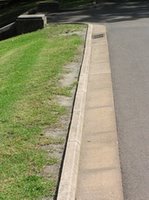

When former Lord Mayor Frank Sartor launched his territorial expansion plans on the former South Sydney City Council at the so called 'independent' Sproatts Inquiry he promoted the City's high levels of service delivery standards. I recall a promise that under contractors there will be no grass longer than 10cm in the city's parks and no rubbish bins more than 60% full. The list went on. Now that I am a member of the Council I am appalled at the state of so much of our outdoor contracted oipen space. The pictures below were taken by a CBD constituent Mr Edward Mandler on a recent Sunday morning at Hyde Park. They show quite clearly basic maintenance short comings. I walked through Hyde Park yesterday afternoon and the bins were full and rubbish strewn across the lawns - clearly after the lunch period 4 hours earlier. The gardens, trees and lawns have that 'unloved' look about them. Outsourcing Hyde park's ongoing maintenance and development is short sighted and budget focused and not in touch with the expectations of the city's residents and visitors. We would not accept the outsourcing of the gardeners at the Botanic Gardens. I have argued this at Council but Clover Moore seems too busy to look at the basics of the City's services and told me to 'take it up with the CEO'. Maybe we need Frank back for the sake of our parks and trees!
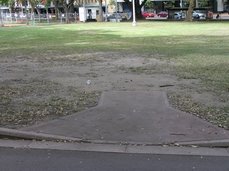
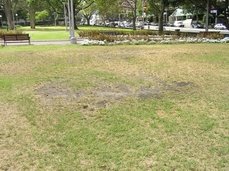
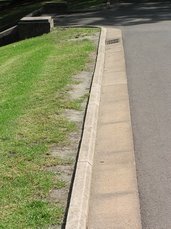
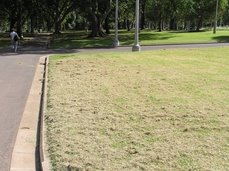
When former Lord Mayor Frank Sartor launched his territorial expansion plans on the former South Sydney City Council at the so called 'independent' Sproatts Inquiry he promoted the City's high levels of service delivery standards. I recall a promise that under contractors there will be no grass longer than 10cm in the city's parks and no rubbish bins more than 60% full. The list went on. Now that I am a member of the Council I am appalled at the state of so much of our outdoor contracted oipen space. The pictures below were taken by a CBD constituent Mr Edward Mandler on a recent Sunday morning at Hyde Park. They show quite clearly basic maintenance short comings. I walked through Hyde Park yesterday afternoon and the bins were full and rubbish strewn across the lawns - clearly after the lunch period 4 hours earlier. The gardens, trees and lawns have that 'unloved' look about them. Outsourcing Hyde park's ongoing maintenance and development is short sighted and budget focused and not in touch with the expectations of the city's residents and visitors. We would not accept the outsourcing of the gardeners at the Botanic Gardens. I have argued this at Council but Clover Moore seems too busy to look at the basics of the City's services and told me to 'take it up with the CEO'. Maybe we need Frank back for the sake of our parks and trees!
Monday, March 06, 2006
Sunday Telegraph reports Clover Moore's Spin City
Clover chooses PR over people
March 5, 2006
SYDNEY Lord Mayor Clover Moore is facing an angry backlash within her own council over her decision to spend more than $1 million on her public relations team at the expense of much-needed community projects.
Ms Moore, who already has 10 media staff and spends $30,000 a month on an external public relations consultancy, now wants to hire a new panel of communication consultants.
The panel comprises seven public relations companies that would be on call to manage special projects.
A council meeting last week approved the extra staff, but funding for maintenance at a local pre-school, a community centre for people with disabilities and a public school was knocked back.
Ms Moore's opponents, including Deputy Lord Mayor Verity Firth, have attacked Ms Moore for her excessive spending.
"On Monday night, the council approved a new panel of media advisers," Ms Firth said.
"At the same meeting, eight capital funding requests from church groups and public schools were knocked back.
"We are spending about $1 million on media advice, when we could be spending it on services for local residents."
The Sunday Telegraph understands former lord mayor Frank Sartor spent about $250,000 a year on media advisers.
In response to questions on notice, Ms Moore said media consultancy firm, Cato Counsel was being paid $30,000 a month.
Liberal councillor Shayne Mallard said his estimate that $1 million was being spent this year on spin doctors was conservative.
He said the unprecedented spending on media and communications officers was part of a plan to help the Lord Mayor get re-elected.
"A new director as part of a new communications department has been created and he is paid at least $150,000," he said.
"Five staff have been built around him, each with salaries of at least $60,000 each, totalling at least $300,000.
"There is also a communications manager for the Officer of Lord Mayor, who is on at least $100,000 and he has one media adviser at about $75,000 and is looking for another."
Among the community projects denied funding at Monday's meeting were a $3080 common area for people with disabilities at the Euralla Community Service and $5000 for urgent maintenance at Green Square Community Church hall.
The Darlinghurst Public School P & C also asked for $5000 to restore the school's fence, install ceiling fans and paint the assembly hall.
The Sunbeam pre-school's request for less than $3000 to provide grass and shade for children was also rejected.
Ms Moore said the communications unit helped promote the city.
"The community projects were thrown in at the meeting when we were dealing with setting up a panel of consultants," Ms Moore said yesterday.
The Sunday Telegraph
Tuesday, February 28, 2006
Spin City
 MEDIA RELEASE
Spin City out of Control at Clover Moore's Town Hall
Liberal Sydney City Councillor Shayne Mallard has criticised the dramatic growth in expenditure under Clover Moore's administration for ‘Communications Consultants’ at the City of
Council is being asked to approve the appointment of a panel of communication consultants for an unspecified amount and with little information provided on their role or cost to the ratepayers. This is in addition to the $30,000 per month now being spent on “
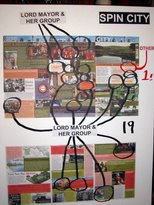
“City News”, a City of
“City News October edition has one reference to non-Moore Councillor Verity Firth and 19 pictures and references to Clover Moore and her village people.”
"If that's not proof that Moore and her staff can not be trusted to act responsibly with Council's communications budget, I'm not sure what is needed."
Residents could easily forget there are five other hard working City Councillors working for the interests of
Much of City News, even its format, is indistinguishable from the cascade of self promotion the Member for Bligh and Lord Mayor unleashes on residents and ratepayers every other month at taxpayer and ratepayer's expense.
The cost of the Lord Mayor’s self promotion could go along way towards other more useful city services.
Councillor Mallard estimated that Communications expenditure at the Council had blown out from approximately $250,000 under Frank Sartor to potentially over a $1 million under Clover Moore.
Councillor Mallard's motion to establish an editorial balance oversight committee was defeated by Clover Moore's casting vote tonight as accountability and transparency was rejected.
27 February 2006
Shayne's Web: www.shaynemallard.com
Shayne's Blog: www.shaynemallard.blogspot.com
City of Sydney:www.cityofsydney.nsw.gov.au
Tuesday, February 21, 2006
Cycling finds A list champion
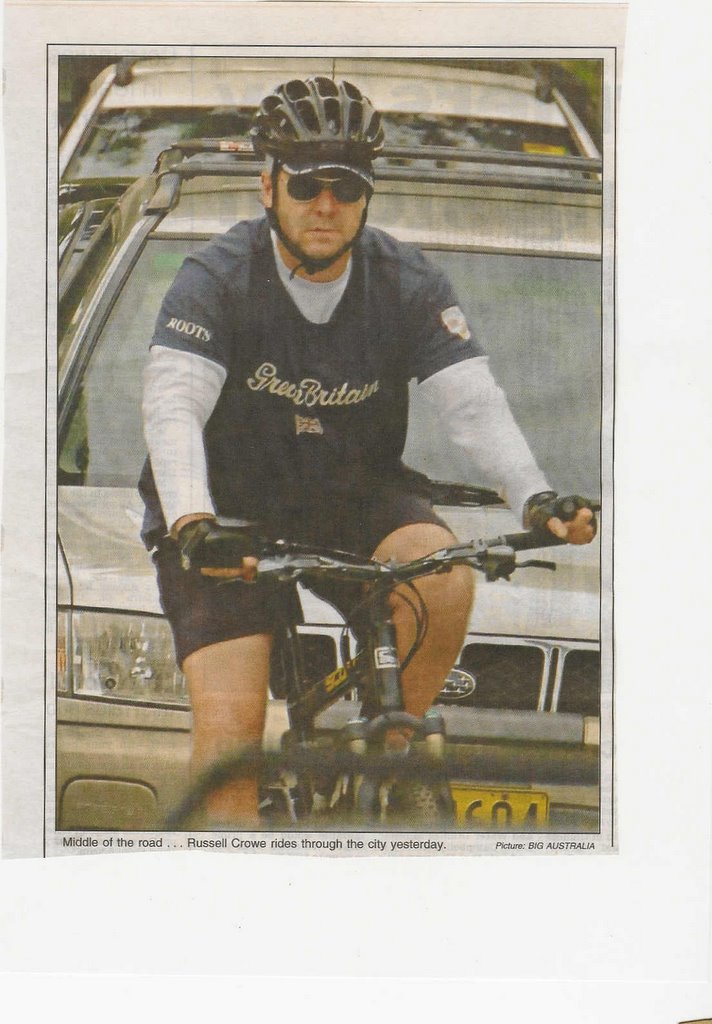
eCouncillor riding his new Norco VFR 4 series bicycle up and down William Street or across Hyde Park hardly raises an eyebrow other than the abuse of ignorant taxi drivers who seem to feel the road is there for them only. Put Hollywood hero and South Sydney's white night Russell Crowe on Elizabeth Street and cycling takes a whole new edge.  As a member of the City of Sydney's Bicycle Steering Committee I will move quickly to enlist Russell's support in building Sydney's engagement with cycling as a viable alternative to walking, driving and public transport. With inner city daily commuter trips by bike as low as 2% in Sydney (with a target range of 6% in Melbourne to 33% in Copenhagen) there are real opportunities and proven positive health, environment and economic benefits by encouraging more cycling. At the same time Council and the State government must continue their investment in cycling infrastructure.
Today's Daily Telegraph carried the pic and story on page 7. On line the picture of Crowe could not be found so I have scanned it in for eCouncillor's cycling friends.
On yer bike
By Dora TsavdaridisFebruary 21, 2006
THE last time he wore a helmet was in Gladiator.Yesterday, Elizabeth St was the venue as Russell Crowe engaged in a different kind of combat - with Sydney's peak-hour gridlock.
And while Crowe is used to stopping traffic as one of cinema's biggest stars, he got a reaction of a different kind yesterday.
One driver was unimpressed with his bike-riding skills and honked him when his bike strayed into the middle of the road.
Crowe is taking a break from films at the moment and is focusing on winning his privatisation bid for the South Sydney Rabbitohs with business partner Peter Holmes a Court.
His dream to own the rugby league team, which he has followed since he was a young boy, will only come true if 75 per cent of club members vote to accept the $3 million deal.
The Woolloomooloo based actor recently finished filming the lead role in a film by Gladiator director, Ridley Scott called A Good Year, which also stars fellow Australian Abbie Cornish.
He plays Max Skinner, an Englishman who inherits a vineyard in the south of France.
Thursday, February 16, 2006
Westfield CBD Proposal goes on Exhibition
 CENTREPOINT DA ON EXHIBITION
I attended the Council's information session held on Valentine's Day this week to give residents, businesses and the public the opportunity to learn more about the $430 million Development Application (DA) lodged by Westfield for CBD commercial and retail premises surrounding Centrepoint.
The City has placed the proposal on public exhibition until 7 March to enable the community and stakeholders to lodge submissions. Westfield is seeking development consent for the Centrepoint, Convention Centre, Imperial Arcade and Skygarden sites, including demolition of parts of the buildings and construction of a new commercial tower and basement parking.
There are a range of legitimate concerns including construction impacts (estimated to be spread over three years), car parking and traffic management and design issues. Consistent concerns are raised about the impact that a mega retail complex will have on the economic viability of neighbouring CBD shopping areas. One retailer from Bondi Junction pointed out his experience with that Westfield project. He noted that the economic impact report for the huge Bondi Junction Westfield development estimated a 3% negative impact upon the surrounding area. He claimed the figure is in fact closer to 30%. In response I am supporting an independent economic impact study to be undertaken. However - the question is; "what can Council do on this front?" At last night's meeting of the Paddington branch of the Liberal party it was suggested by one that the City of Sydney simply refuse the DA. That is reject the $430 million investment in the tired looking Centrepoint and Pitts Street Mall retail core of the CBD and effectively hand the decision to the courts. It should also be noted that Council is not the consent authority on this DA but rather it is the CSPC of which I am a member. I would welcome any feedback on this DA.
To view the full application, visit the CityÂ’s website.
.
Thursday, February 09, 2006
Green Square another step closer....Not before time.
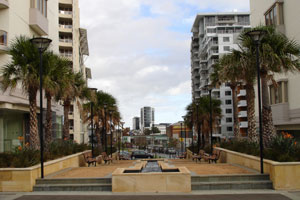
The City has finally at long last released the next phase of the Green Square Town Centre development, with the latest Draft Local Environment Plan (LEP). The current LEP is a revised draft of the original version prepared in 2003 by the former South Sydney City Council prior to amalgamation.
There has been a further 2 year delay in reviewing the original Green Square LEP proposed by South Sydney with no significant differences in the two proposals. Simply another delay to frustrate land owners, investors and the community in Green Square who are keen to see new shopping centre and other amenities promised.
Meantime the Lord Mayor Clover Moore is using ratepayer's money to seek legal advise and gearing up Council to fight the proposed Sydney Airport redevelopment in the Botany Council area. One of her arguments is the damage the airport development could do to the Green Square area. Now that the Council will finally adopt a new LEP for the area the property industry might take seriously the years of Green Square hype and glossy brochures and look at making some real economic and job creating investments. The race is on and the City of Sydney needs to be out there ahead of the Airport Corporation with sleeves rolled up prepared to work with the property industry to achieve excellence in economic, social and urban design outcomes. If the airport developments do damage Green Square's viability and future growth then the Council must accept part of that blame.
From the Council report:
"With the cost of essential infrastructure expected to exceed $103 million, full implementation of the new Town Centre is anticipated to evolve over a period of more then 10 years.
Based on a number of technical studies to ensure the best outcomes are delivered, the vision for Green Square is to provide a new and vibrant town centre where people will live, work, shop, dine out, be entertained and take part in cultural and community activities.
The proposed development will include two key public plazas, a landscaped boulevard with cycle and pedestrian paths, parks and other communal spaces.
City of Sydney will host a planning Forum on 18 February 2006 from 12.30pm to 2.30pm at the Green Square Community Facility, 3 Joynton Avenue Alexandria. "
Wednesday, February 08, 2006
Kung Hei Fat Choy!!!
The biggest parade outside China
On Sunday a massive crowd of fifty thousand lined George Street to celebrate the Chinese new year. Hundreds of performers from Beijing joined local groups to put on a spectacular show. "Brilliant colourful costumes" said one observer. Organiser Robert Kok was qouting saying "This cements Sydney as the largest Chinese New Year festival outside of Hong Kong". It was indeed a chance for the local Australians to see Chinese traditional culture, the Year of the Dog brings friendship and good fortune.
The Australian reports:
Fifty thousand spectators turned out to watch more than 500 performers from Beijing, promoting the 2008 Olympics with the Games' slogan "One World One Dream", lead the parade of more than 2000 performers from 50 different groups. But something you won't be seeing in Beijing -- spiritual group Falun Gong -- took up the rear.
The group, banned in China, used the parade to spread its message that the Chinese Government has oppressed and terrorised it unmercifully.
My PA James Farrar took some great photos and they are available to view here: http://www.digifolio.biz/feature-2006parade.asp
On Sunday a massive crowd of fifty thousand lined George Street to celebrate the Chinese new year. Hundreds of performers from Beijing joined local groups to put on a spectacular show. "Brilliant colourful costumes" said one observer. Organiser Robert Kok was qouting saying "This cements Sydney as the largest Chinese New Year festival outside of Hong Kong". It was indeed a chance for the local Australians to see Chinese traditional culture, the Year of the Dog brings friendship and good fortune.
The Australian reports:
Fifty thousand spectators turned out to watch more than 500 performers from Beijing, promoting the 2008 Olympics with the Games' slogan "One World One Dream", lead the parade of more than 2000 performers from 50 different groups. But something you won't be seeing in Beijing -- spiritual group Falun Gong -- took up the rear.
The group, banned in China, used the parade to spread its message that the Chinese Government has oppressed and terrorised it unmercifully.
My PA James Farrar took some great photos and they are available to view here: http://www.digifolio.biz/feature-2006parade.asp
Thursday, February 02, 2006
Flag Burning for Democracy & Danes Singled Out
 There has been a bit of good old fashioned offensive flag burning going around in the past few days. You couldn't help but notice the in-your-face offensive action on 26 January, Australia Day when a disgraceful Aboriginal protest in Brisbane not only climaxed with the burning of the Australian flag on our day of national celebration but to add class to the occasion the gathered rat bag Aborigines spat on the flaming flag. This action captured in all its vulgarity on TV failed to make the printed press with any pictures (if I'm wrong please let me know where it is on-line). Seems a bit of press PC editing. A great way to help the rest of Australia understand and sympathise with their feelings about white settlement and civilisation of Australia.
Clover Moore used the Australia Day ceremony in Hyde Park to tell all gathered that to Aboriginal people Australia Day is not a day of celebration but marks the day of invasion. Well it is always helpful when Clover Moore presumes to represent the views of the 'community' and in particular a very diverse community - many of whom disassociated from the 'sorry day' agenda and Brisbane flag burning. Much like she did when Aboriginal radicals squatted and set up a camp network in Victoria Park in 2004 declaring it a sovereign nation - abusing Clover's naivete and resulting in a secret deal and midnight Council eviction.
 The Australia Day ceremony was climaxed by a dog fight metres from eCouncillor and triggered by an off lead pit-bull terrier ironically owned by an Aboriginal man (again not reported in the press) - the nasty dog fight was settled by a dozen police with battens and capsicum spray that drifted across the gathered crowd. eCouncillor's picture taken immediately after the fight, of the pit-bull owner forced to sit by police as the savage dog is removed from his possession. Clover Moore might overlook the diversity in views (if they don't agree with hers) but the Prime Minister can understand diversity when he dismissed the Ausie flag burning by Aborigines as an offensive action but not representative of mainstream Aboriginal views. A very mature political response. The PM rightly went on to oppose any laws to outlaw flag burning.
Laws against flag burning raise mixed emotions and responses particularly in the nation with more flags burnt than any other - USA. State laws to outlaw flag burning have been struck down by the US Supreme Court as violating the first amendment protecting the rights to free speech. As a traditional liberal who views freedom of speech as a fundamental plank of democracy, I support that view. But what happens in Australia if at an anti-war rally the Australian flag is incinerated? Would that be sedition under the new laws? and what if the religious right burnt 'rainbow gay flags' in an anti Mardi Gras protest? would that trigger NSW anti-vilification laws? If an Aboriginal flag were set alight by far right activists? What of the young man gaoled for 3 months for stealing an Australian flag and setting it alight during the shameful riots in Cronulla. Where does freedom of speech end and inciting violence begin? Burning any flag whilst insensitive and offensive is a freedom of speech right and generally serves only to polarise opinion and often isolate the provokers.
 Talking of over sensitivity - the Muslim nations attacking Denmark for the publishing of several cartoons offending their religious sensitivity are clearly an over-reaction frenzy with another agenda.
"We have from the beginning said that these drawings are making Muslims angry and hurt. But we honestly never thought that this case would develop to the point where Danish products in the Middle East are being threatened to this extent," Ahmed Abu Laban, a prominent imam in Denmark, said in a statement.
Saudi Arabia has recalled its ambassador to Denmark, Libya has shut down its embassy, and Iraq's Foreign Minister has summoned Denmark's ambassador over the cartoons.
Interior ministers from 17 Arab countries have called on the Danish Government to "punish the authors", while thousands of Palestinians have demonstrated in Gaza City and Tel Aviv.
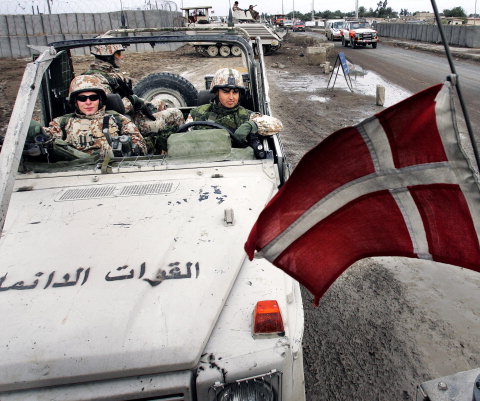
The burning of the Danish flag, withdrawal of ambassadors (why would you re-admit the Libyans anyway?) and painful economic boycott of Danish exports has more to do with Denmark's significant role in Iraq and the Danish government's strong proactive management of the 200,000 Muslims in their essentially Lutheran mono-culture. Publishing a few cartoons in the independent and free press that make an extreme comment about another culture is no more offensive than burning flags. Reports that a fatwa has been issued against Danish troops in Iraq are proof of the extremist agenda.
"I can confirm that we've heard about the fatwa from a reliable source in Iraq ... so we believe it's true," Defence Minister Soeren Gade's spokesman Jacob Winther told AFP.
The report came amid rising Muslim anger over 12 cartoons published in Danish daily Jyllands-Posten last September depicting the Prophet Mohammed. The crisis is threatening Danish trade relations with the Muslim world.
Danish flags have been burnt, products have been boycotted and threats of violence have been issued against Scandinavians in Muslim countries in recent days.
 When President Bush visited Copenhagen last July left wing Danish protesters burnt both the US and Danish flags. A debate ensued about laws against burning flags but the Danes came down on the side of freedom of speech. It's a shame that other cultures and nations are not (more?) tolerant.
This morning we awoke to some spine from the Europeans and a stand to protect freedom of speech.
Europeans back Danes over press freedom
By Molly Moore in ParisFebruary 3, 2006
Religious uproar … an Egyptian supermarket is stripped of Danish products.Photo: AFP
NEWSPAPERS across Europe have reprinted cartoons ridiculing the prophet Muhammad, saying they wanted to support the right of Danish and Norwegian papers to publish caricatures that have ignited anger among Muslims....
France Soir said it had published the "incriminating caricatures" because "no religious dogma can impose itself on a democratic and secular society".
The newspaper's front-page headline declared: "Yes, we have the right to caricature God", accompanied by a cartoon depicting religious figures from the Muslim, Jewish, Buddhist and Christian faiths on a cloud. The Christian is shown saying, "Don't complain, Muhammad; we've all been caricatured here."
We await eagerly the publication of the cartoons in Australia....
See the Danish cartoons causing all the fuss in the Muslim world here.
Tuesday, January 31, 2006
REFORMS NEEDED TO STOP DISABILITY PARKING RORTS
REFORMS NEEDED TO STOP DISABILITY PARKING RORTS & INCREASE SPENDING ON INFRASTRUCTURE FOR THE DISABLED
'You're being watched' was the warning - but not enough action has been taken to stop the abuse of the parking permits for disabled parking.
In response to growing concern and anger over the evident rorting of the disability parking concession system, Liberal City of Sydney Councillor Shayne Mallard has proposed an overhaul of the permit system to include tighter parking controls, higher fines for abuse of the system and more accessible taxi and community transport schemes.
Councillor Mallard's goal is to restore the community's faith in the disability parking scheme, protect genuine beneficiaries of the system and to recover potential lost parking fee revenue which should be channelled to much needed improved CBD disability amenities and infrastructure such as street ramps and stairway lifts.
"The State government and City must overhaul its parking permit regulations, they are failing all concerned including workers and visitors who are forced to compete for fewer spots, the Council is losing revenue and people with disabilities are no better off with the abuse of their system." said Clr Mallard.
Councillor Mallard proposed not only an increase of penalties but a cap on the unlimited time parking feature of disabled permits ; "instead of unlimited time at a meter of restricted parking space, it should be capped to a maximum time of four hours free parking. Most carers and people with disabilities should be able to attend to their business within that time frame."
Councillor Mallard pointed out that a subsidised taxi fare scheme is available to most people with disabilities. "Perhaps the subsidy for taxi fares or a new Council operated community transport scheme needs to be looked into," Mallard suggested.
Shayne Mallard acknowledged the potential loss of revenue for the Council by people abusing the parking privileges. "It certainly suggests that possibly many thousands or even millions of dollars are being lost here as well as the equitable rotation and sharing of parking spaces in support of businesses."
If implemented Shayne Mallard proposes that the parking meter revenue recovered should be channelled into further infrastructure and services for the disabled . "The City has a long way to go in providing safe level pedestrian paths and corner ramps suitable for people with disabilities. The revenue could be earmarked for improvements to disability infrastructure in the City and not just disappear into general Council revenues."
"If as suggested up to 50% of parking spots are taken up by cars with apparent abused disabled stickers then the RTA needs to be more diligent in handing out such free passes as well."
Councillor Mallard emphasised that any urgent reform to the system must be undertaken in full consultation with disability groups and other stakeholders including carers and the medical profession.
"A 'blitz' on abuse may help, but in the longer term there are some simple changes we can make to reach a fairer system for all concerned , particularly those with a real need for disability parking and importantly restore community confidence in the scheme," Mallard concluded.
Councillor Shayne Mallard
Warning, you're being watched
By Matthew Moore
January 31, 2006
TAKE a walk through any street in Sydney where there are parking meters and you can expect to find more than 50 per cent of cars with mobility stickers stuck to their windscreens.
The stickers allow all-day free parking in disabled spaces, as well as any metered area where parking for an hour or more is permitted. Of course, they are only supposed to be used when transporting a person with a disability.
The Herald was flooded with complaints of able-bodied people abusing the scheme after an article was published on Saturday highlighting the problem on one city block in Kent Street.
In the same block, between Market and King streets, it was business as usual yesterday with 15 out of 33 cars displaying the mobility parking tags and avoiding the need to pay.
The manager of one building in the street, who has asked not to be named, said he had noticed a steady increase in the number of cars using the stickers in recent years.
"They are mainly professional people. They are rorting this scheme for the handicapped and depriving the ratepayers of hard-to-get revenue," he said.
"They come in the morning and they don't move all day. It leaves a sour taste in your mouth to see people exploiting the system."
Further up Kent Street in the block north of Margaret Street, nine out of 14 cars were using the stickers at midday.
Around the corner in Napoleon Street, nine out of 19 cars had the park-anywhere-for-free stickers, including a Mitsubishi with a new permit that lasts until 2009.
If the City of Sydney Council is worried about loss of revenue resulting from the scheme's abuse, it is not saying. It made $16.5 million from its parking meters last year by charging $4.40 an hour during business hours, but a council spokesman, Josh Mackenzie, declined to estimate how much revenue might be forgone each day.
One reader, Gordon Pelletier of Cremorne, said: "Go to Paddy's Market, particularly on a Saturday after 7am, to see street after street packed with cars showing disabled stickers. Most of the drivers appear to be able-bodied vendors at the markets who rely on their disabled stickers to park all day for free while they make money selling at the markets."
Ian Muir, of Lavender Bay, said: "On any given weekday in business hours, up to half the cars parked here have disability permits to the point where genuine locals and their visitors are being denied parking."
Roads in Bondi, Chatswood, Ultimo, Haberfield and any street near a university were also nominated by readers as areas in which the scheme's systemic abuse was obvious.
But despite the anger, there is no agreement on how the abuse might be reduced. John Moxon, the vice-president of the Physical Disability Council of NSW, said the Roads and Traffic Authority had invited his group to a forum on the scheme when the Herald began making inquiries about it.
Mr Moxon said that while he was concerned about the scheme's abuse, he thought the only way to reduce it would be to carry out an occasional blitz that caught out people misusing the disabled-parking tags.
Tuesday, January 24, 2006
Fish ban will damage our international image

The State government has announced that commercial and recreational fishing in the huge Sydney Harbour will be prohibited owing to the dangerously high levels of dioxin found in fish and prawns. There is no indication of how long the ban will be in place and why this life threatening situation had not been detected earlier.
This is a sad set-back for what in recent years had been very positive signs of an improving water quality in the Harbour including the regular presence of whales and the growing numbers of recreational anglers dotted around the shore line. I regularly see families fishing quite successfully off the Finger Wharf and Mrs Macquaries Chair. They will now be instructed to catch and release only and not consume the fish. This will require a carefully targeted message for newly arrived Australians who make up a significant group fishing along the shore. Forcing any fisherman to throw back a legal sized healthy looking fish will be a new challenge for the authorities.
The cancer causing dioxins are leaching into the Harbour from former industrial sites located around Homebush Bay including the former Union Carbide site at Meadowbank near Ryde. Urgent remediation of the western reaches of Sydney Harbour must become a national priority. There is no doubt that news of poisonous fish in our postcard world famous harbour will alarm some tourists and damage our image as an environmentally pristine country. It will make eating fresh fish at Doyles a little bit harder to swallow.
Saturday, January 21, 2006
Light Rail better option than London's Congestion Tax
More on light rail. Former City of Sydney Councillor, architect and columnist Elizabeth Farelly puts her weight behind light rail for our city street and surprisingly opposes a London style congestion tax on an equity argument. I agree with her observations that street narrowing (it's ironic that 100 years ago we were widening streets like Oxford and William) has the effect through added congestion to deter motorists making unnecessary trips into the CBD. Push bike sales are going through the roof and you just have to look around our CBD streets to see more people riding bikes. Great picture below from the SMH today.
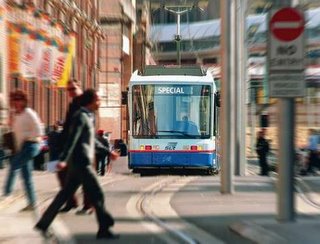
The cure for blocked arteries
Photo: Quentin Jones
By Elizabeth FarrellyJanuary 21, 2006
As Sydney traffic moves closer to unbearable congestion, it is time to develop the only real solution: light rail.
When I lived in London years ago, no one I knew drove into the city centre. No one would dream of doing such a thing - except, surprise, Australians and New Zealanders. Helplessly individualist, the downunderers figured that getting bogged on Regent Street or Oxford Circus was at least going to be picturesque, given the endless pedestrian throng. What they weren't getting, though, was that London was no longer that kind of city.
Cities, like stars or children, have developmental stages. When they're young and fresh and loose-limbed, cities can be driven around with ease. Locals look forward to the first set of traffic lights and lose hair over a five-car "jam". Past a certain size and density, though, cities can no longer support mass private transport, except of the two-wheeled variety. Ten and even 20 years ago, London was well past this driveable limit. A corollary, though, was that travelling by bus or train, even to the opera, was entirely respectable.
Sydney, nearing the end of its teens, now teeters at the same threshold. We all remember the golden fortnight of the Olympics, when parking was banned and traffic flowed smoothly. Otherwise, though, and recognising that no politician will brave the retail backlash that a permanent parking ban would entail, something will have to be done. Something serious. As the transport consultant Garry Glazebrook says in a report to the City of Sydney council, "Sydney needs a world-class transport system ... to remain a world-class city".
Glazebrook's proposal involves parking limits, integrated ticketing, wider cycle lanes and car sharing. Its main plank, though, is a five-legged light-rail system hooked into the existing one at Central Station. It involves a CBD loop (either two-way on George Street, two-way on Castlereagh Street or one-way on Pitt and Castlereagh streets), with arms reaching to Bondi (via Bondi Junction), Burwood (via Lilyfield), Mascot, Parramatta Road and Maroubra Junction (via the University of NSW). These are the obvious routes for Sydney and would hugely de-stress Central and Town Hall stations, both now nearing capacity. But the State Government remains unmoved, not to say inertial, on public transport and deeply committed to roads.
Most cities facing congestion crises try roads first. Roads, as the instant-gratification response, have ballot-box appeal. They're quick, cheap, popular and easy to plaster on. What they don't do, though, is solve the problem. As the Glazebrook report points out, despite the $10 billion we have poured into major Sydney road projects over the past decade, traffic on other inner-city roads - which could be expected to drop - has actually risen over the same period by 20 per cent.
This, on the face of it, is mysterious. More road space should ease congestion, right? But road spending never reduces city traffic in the long term because making driving easier feeds our all-too-human tendency to do more of it. It is inverse demand management: boosting supply actually boosts demand. So, although Sydney congestion is exacerbated by narrow streets and strict boundaries, even the most generous road pattern (such as, say, Manhattan's) will eventually clog. Roads may defer the crisis, but never prevent it. That's the conundrum.
But if roads are not the answer, what is? London, under mayor Ken Livingstone, introduced the congestion tax. Now, two years on, it seems to be working, up to a point, with initial 20 per cent traffic reductions having stabilised around 16 per cent. Revenues to the city, although less than expected (because of decreased traffic), are about $160 million, and from next year the taxable area will expand across Chelsea, Westminster and Kensington.
But the downside, in equity terms, is that, at $19 a pop, the congestion fee restricts road use to the well-heeled and business-funded, directly undermining the publicness of public space. Try being a single parent on the day-care run and see how an extra $19 a day feels.
Similar taxes are regularly proposed for Sydney. My view, though, is that there are better, fairer ways. Such as light rail.
The core principle of traffic reduction is making driving not easier, but harder. A congestion tax does this, but favours the wealthy. A similar result would be achieved by road narrowing (or footpath widening), but of course this, too, reduces access, albeit in a more equitable way, and relies on congestion to be self-limiting. Devoting a proportion of road surface to light rail, on the other hand, is a neat solution, since it reduces traffic but also increases people flow in a clean, low-noise way.
Light rail can carry up to 300 people a vehicle, four times bus capacity, according to Glazebrook. It runs on electricity, so while not exactly pollution-free it does relocate the pollution to the point of generation, instead of puffing particulates and nitrogen oxides into the face of every pedestrian. And it's low-noise, unlike the filthy, roaring diesel buses to which the NSW Government reverted last year after all those promises of a clean, gas-powered fleet.
Not only that, but light rail is quick, reliable and frequent, with the proposed Sydney system sending off a loop-train every two minutes. It's also fitness-enhancing, in that (like all public transport) light rail supplements walking rather than replacing it, as do cars. With one in four young Australians obese or overweight, this alone should persuade us.
So convincing, indeed, are these arguments, and so thoroughly proved, that about 400 light rail systems now operate in cities around the world, with more than 100 cities having built or expanded their systems in the past decade. Many cities that tore up extensive tram networks - including Paris, London, Strasbourg, New Orleans and Pittsburgh - are now acknowledging the mistake and re-installing light rail.
In Sydney, the decision to replace one of the world's largest tram networks with buses was taken in 1957 by government transport commissioner A.A. Shoebridge, shortly before he took a job with one of the big tyre companies.
So what, in view of all this, stops Sydney joining the re-installation club? Why is light rail in Sydney habitually supported by local governments, oppositions and lobby groups - all of them unable to effect it - but pooh-poohed by those with the power?
The reasons are fourfold: light rail's relatively high capital cost (although, at an estimated $1.2 billion to $1.6 billion, the proposed system is only slightly dearer than the billion-dollar Cross City Tunnel and comparable to the Epping-Chatswood Rail Link); the relatively long roll-out time (which dilutes ballot-box yield for the three-year attention span); probable mayhem during construction; and the all-powerful roads lobby, which uses the monorail as whipping boy.
Still, the construction mayhem is temporary, unlike the retail blight resulting from a congestion tax such as London's. The roll-out time can be beneficial, since it makes the project stageable. And on cost, light rail has three times the carrying capacity of even the Epping-Chatswood link, which makes it substantially cheaper in terms of dollars per passenger kilometre and little more than half as expensive as the Cross City Tunnel.
And the monorail? Well, call me paranoid, but if I were an oil tsar seeking to prove public transport a failure, I'd fund something like the Sydney monorail.
All that notwithstanding, though, with transport systems at capacity and both population and jobs expected to grow by a further 20 per cent inside 15 years, Sydney has reached the point at which light rail becomes the obvious, and in many ways the only, solution. For once the answer is easy. Light rail: do it.
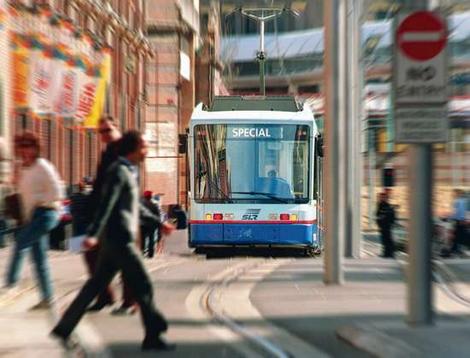
The cure for blocked arteries
Photo: Quentin Jones
By Elizabeth FarrellyJanuary 21, 2006
As Sydney traffic moves closer to unbearable congestion, it is time to develop the only real solution: light rail.
When I lived in London years ago, no one I knew drove into the city centre. No one would dream of doing such a thing - except, surprise, Australians and New Zealanders. Helplessly individualist, the downunderers figured that getting bogged on Regent Street or Oxford Circus was at least going to be picturesque, given the endless pedestrian throng. What they weren't getting, though, was that London was no longer that kind of city.
Cities, like stars or children, have developmental stages. When they're young and fresh and loose-limbed, cities can be driven around with ease. Locals look forward to the first set of traffic lights and lose hair over a five-car "jam". Past a certain size and density, though, cities can no longer support mass private transport, except of the two-wheeled variety. Ten and even 20 years ago, London was well past this driveable limit. A corollary, though, was that travelling by bus or train, even to the opera, was entirely respectable.
Sydney, nearing the end of its teens, now teeters at the same threshold. We all remember the golden fortnight of the Olympics, when parking was banned and traffic flowed smoothly. Otherwise, though, and recognising that no politician will brave the retail backlash that a permanent parking ban would entail, something will have to be done. Something serious. As the transport consultant Garry Glazebrook says in a report to the City of Sydney council, "Sydney needs a world-class transport system ... to remain a world-class city".
Glazebrook's proposal involves parking limits, integrated ticketing, wider cycle lanes and car sharing. Its main plank, though, is a five-legged light-rail system hooked into the existing one at Central Station. It involves a CBD loop (either two-way on George Street, two-way on Castlereagh Street or one-way on Pitt and Castlereagh streets), with arms reaching to Bondi (via Bondi Junction), Burwood (via Lilyfield), Mascot, Parramatta Road and Maroubra Junction (via the University of NSW). These are the obvious routes for Sydney and would hugely de-stress Central and Town Hall stations, both now nearing capacity. But the State Government remains unmoved, not to say inertial, on public transport and deeply committed to roads.
Most cities facing congestion crises try roads first. Roads, as the instant-gratification response, have ballot-box appeal. They're quick, cheap, popular and easy to plaster on. What they don't do, though, is solve the problem. As the Glazebrook report points out, despite the $10 billion we have poured into major Sydney road projects over the past decade, traffic on other inner-city roads - which could be expected to drop - has actually risen over the same period by 20 per cent.
This, on the face of it, is mysterious. More road space should ease congestion, right? But road spending never reduces city traffic in the long term because making driving easier feeds our all-too-human tendency to do more of it. It is inverse demand management: boosting supply actually boosts demand. So, although Sydney congestion is exacerbated by narrow streets and strict boundaries, even the most generous road pattern (such as, say, Manhattan's) will eventually clog. Roads may defer the crisis, but never prevent it. That's the conundrum.
But if roads are not the answer, what is? London, under mayor Ken Livingstone, introduced the congestion tax. Now, two years on, it seems to be working, up to a point, with initial 20 per cent traffic reductions having stabilised around 16 per cent. Revenues to the city, although less than expected (because of decreased traffic), are about $160 million, and from next year the taxable area will expand across Chelsea, Westminster and Kensington.
But the downside, in equity terms, is that, at $19 a pop, the congestion fee restricts road use to the well-heeled and business-funded, directly undermining the publicness of public space. Try being a single parent on the day-care run and see how an extra $19 a day feels.
Similar taxes are regularly proposed for Sydney. My view, though, is that there are better, fairer ways. Such as light rail.
The core principle of traffic reduction is making driving not easier, but harder. A congestion tax does this, but favours the wealthy. A similar result would be achieved by road narrowing (or footpath widening), but of course this, too, reduces access, albeit in a more equitable way, and relies on congestion to be self-limiting. Devoting a proportion of road surface to light rail, on the other hand, is a neat solution, since it reduces traffic but also increases people flow in a clean, low-noise way.
Light rail can carry up to 300 people a vehicle, four times bus capacity, according to Glazebrook. It runs on electricity, so while not exactly pollution-free it does relocate the pollution to the point of generation, instead of puffing particulates and nitrogen oxides into the face of every pedestrian. And it's low-noise, unlike the filthy, roaring diesel buses to which the NSW Government reverted last year after all those promises of a clean, gas-powered fleet.
Not only that, but light rail is quick, reliable and frequent, with the proposed Sydney system sending off a loop-train every two minutes. It's also fitness-enhancing, in that (like all public transport) light rail supplements walking rather than replacing it, as do cars. With one in four young Australians obese or overweight, this alone should persuade us.
So convincing, indeed, are these arguments, and so thoroughly proved, that about 400 light rail systems now operate in cities around the world, with more than 100 cities having built or expanded their systems in the past decade. Many cities that tore up extensive tram networks - including Paris, London, Strasbourg, New Orleans and Pittsburgh - are now acknowledging the mistake and re-installing light rail.
In Sydney, the decision to replace one of the world's largest tram networks with buses was taken in 1957 by government transport commissioner A.A. Shoebridge, shortly before he took a job with one of the big tyre companies.
So what, in view of all this, stops Sydney joining the re-installation club? Why is light rail in Sydney habitually supported by local governments, oppositions and lobby groups - all of them unable to effect it - but pooh-poohed by those with the power?
The reasons are fourfold: light rail's relatively high capital cost (although, at an estimated $1.2 billion to $1.6 billion, the proposed system is only slightly dearer than the billion-dollar Cross City Tunnel and comparable to the Epping-Chatswood Rail Link); the relatively long roll-out time (which dilutes ballot-box yield for the three-year attention span); probable mayhem during construction; and the all-powerful roads lobby, which uses the monorail as whipping boy.
Still, the construction mayhem is temporary, unlike the retail blight resulting from a congestion tax such as London's. The roll-out time can be beneficial, since it makes the project stageable. And on cost, light rail has three times the carrying capacity of even the Epping-Chatswood link, which makes it substantially cheaper in terms of dollars per passenger kilometre and little more than half as expensive as the Cross City Tunnel.
And the monorail? Well, call me paranoid, but if I were an oil tsar seeking to prove public transport a failure, I'd fund something like the Sydney monorail.
All that notwithstanding, though, with transport systems at capacity and both population and jobs expected to grow by a further 20 per cent inside 15 years, Sydney has reached the point at which light rail becomes the obvious, and in many ways the only, solution. For once the answer is easy. Light rail: do it.
Subscribe to:
Posts (Atom)