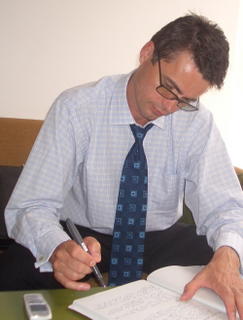
Turnbull takes on mission for gay and lesbian rights
Phillip Coorey and Sherrill Nixon August 13, 2007
MALCOLM TURNBULL has embarked on a personal crusade to convince his cabinet colleagues to allow same-sex couples the same legal and financial rights as heterosexual married and de facto couples. With cabinet preparing to discuss proposed changes, possibly as early as today, the Herald has learnt that Mr Turnbull, the federal Minister for the Environment, has stepped up his push by individually lobbying fellow ministers for support.
The discrimination faced by same-sex couples was highlighted a month ago when the High Court judge Michael Kirby called for the law to be changed so his partner of 38 years, Johan van Vloten, could have access to a part-pension payable for life should Justice Kirby die first. This right would be automatic if Mr van Vloten were female. The Human Rights and Equal Opportunity Commission published a report in June finding same-sex couples were discriminated against in 58 areas of financial and work-related entitlements.
The Attorney-General, Philip Ruddock, is refusing to comment on the state of deliberations or what he will be taking to cabinet, but the Herald understands Mr Turnbull was involved in helping draft the proposals and wants to steer them through cabinet."It's Turnbull who's been pushing for the reforms since the [commission] report," a colleague said.
The backbenchers Warren Entsch, Greg Hunt and Peter Slipper have also lobbied intensely. Mr Turnbull's eastern suburbs seat of Wentworth has a large gay and lesbian population, but a colleague of Mr Turnbull said his motive went beyond retaining his seat. Mr Turnbull's wife, Lucy, is the chairwoman of the AIDS Trust, and the Turnbulls have often raised money for the Bobby Goldsmith Foundation. Read more here.
Wednesday, August 15, 2007
Wentworth Fun Run
Friday, August 03, 2007
Catching up with Paris on Cycling...

Paris bike scheme clocks up 1m rides
Parisians have taken a shine to their city's new bike rental scheme, clocking up 1 million rides since its launch, Paris city hall has announced. More than 10,000 gleaming grey "Velib" bicycles went up for rental at 750 stations across the city on July 15. Their number is set to double to 20,600 by the end of the year. City authorities want residents and tourists to adopt the eco-friendly new system enmasse. Deputy Mayor for Transport Denis Baupin says each bike is already used on average six times per day.
"Once all the stations are up and running, Velib will be carrying as many people as the Paris tramway,"
Velib, a contraction of the French words "velo" (bike) and "liberte" (freedom), is modelled on a successful scheme in the city of Lyon run by advertising giant JC Decaux. JC Decaux is covering the cost of the venture in exchange for exclusive rights to 1,600 hoardings across the city. Registered bikers pay 29 euros ($A46) a year for the rental service, while occasional cyclists can use a credit card to pay a one-off daily fee of 1 euro ($1.60) or weekly charge of 5 euros ($8). Rental is free for the first half hour, rising to 1 euro for the second, 2 for the next and so on - a progressive fee system that is designed to encourage short rents and quick turnover.
Paris joins such European cities as Barcelona, Geneva, Stockholm, Oslo and Vienna, which offer bicycle rentals to try to reduce the number of cars, improve air quality and provide a fun alternative to underground transport.
Tags: environment, france
Saturday, July 14, 2007
Green Poles highlights wasted money under Lord Mayor Clover Moore
Mayor's green revolution nails its colour to the pole
Sunanda Creagh SMHMORE than a quarter of a million dollars have been spent painting silver street poles green since Clover Moore became the Lord Mayor of Sydney. Council papers reveal that over the past three years, 5000 galvanised signposts, light poles and traffic signals have been given the forest green make-over, costing $260,500 - more than $50 a pole. The Liberal councillor Shayne Mallard called the project "an outrageous waste of money".
"The council could have used that money to initiate a program of grants to struggling rural councils or bringing people into the city for a holiday from the drought," he said. "Here we are, the state's art gallery can't afford CCTV and we're painting poles green."
Cr Moore defended the paint jobs as part of a broader effort to beautify streetscapes, which began under the council's former chief executive Peter Seamer.
"In June 2004 council unanimously adopted the recommendation of my Lord Mayoral Minute to improve the public domain by reducing signage clutter in the City of Sydney. New poles are now purchased powder coated, which is more durable and economical than painting on site," she said.
Wednesday, June 27, 2007
New look CSPC strengthens Sartor's control over City Planning Future
The CSPC is a hybrid committee with four government appointments and two Councillors and the Lord Mayor created by legislation to keep town hall politics out of the big end of town planning matters. eCouncillor has been a member elected by the Council since 2005.
The CSPC not only deals with all developments valued at more than $50 million, it also importantly controls the content of new planning rules (LEP's). Currently the City is developing a new LEP called the City Plan, this is running two years behind Clover Moore's original promised completion date and delivered by a strategic planning department without a Director - a void filled by an over-stretched CEO. One suspects the new more assertive looking CSPC will move quickly to take greater control over the City Plan agenda. Watch this space.....
Sartor's former staff replace key architect
Catharine Munro, Urban Affairs EditorJune 27, 2007
THE Government Architect has been removed from a significant role in city planning by the Planning Minister, Frank Sartor, even though the Government had assured Parliament he had no intention of doing so.The Government Architect, Peter Mould, will no longer serve on the Central Sydney Planning Committee, which approves any development worth more than $50 million in the CBD.
"The City of Sydney is back under the control of Frank Sartor," said Shayne Mallard, a Liberal councillor who serves on the planning committee.
Mr Sartor announced yesterday that three of his key departmental planners, along with the architect Keith Cottier, would serve on the board. But Mr Mould, who answers to the Department of Commerce rather than the Department of Planning, did not have his contract renewed.
"I think you need to refresh things," Mr Sartor said. "The skill set has been changed to match the current challenge, and that's all I have done."
Since two positions were due to expire this week, he said, he had decided to change all state-appointed spots. But the Lord Mayor of Sydney, Clover Moore, who chairs the committee, said it was "a pity to lose the current members' expertise and particularly the significant role played by the Government Architect".
Among the appointments are three people who worked under Mr Sartor at the City of Sydney, where he was lord mayor from 1991 to 2003. They include Gail Connolly, the executive director of Metropolitan Planning, who would be able to ensure that the City of Sydney's sustainable strategies and those of the Department of Planning were aligned, Mr Sartor said. Also on the committee will be Jason Perica, another former planner with the City of Sydney, who is now the executive director, strategic sites at the department. A former government architect, Chris Johnson, who is the head of cities and centres at the department, will also serve again.
While Mr Sartor said the appointments followed the law governing appointments, the City of Sydney Act 1988, the Royal Institute of Architects labelled the decision
"disappointing".
"The Government Architect of NSW has historically played a very important role in the architecture of the city," said the institute's national president, Alec Tzannes. Among its roles, the committee is overseeing the development of a local environment plan, which will govern planning rules for the local government area. Last November, when amendments to the act were passed just before the state election, Mr Sartor's representative in the upper house, John Della Bosca, told Parliament he had been assured there was no intention of change.
"This minister has advised me that he has no intention of removing the Government Architect from this appointment," Mr Della Bosca said.
Other new appointments to the committee include Christine Covington, a lawyer with planning experience, and Elizabeth Crouch, a former policy director with the Housing Industry Association. The director-general of the Department
of Planning, Sam Haddad and Mr Perica would serve as alternate board members,
along with Mr Cottier.
Wednesday, June 13, 2007
'Independent' monopoly held by Moore
Mayoral contender from the arts end of London
Sunanda Creagh Urban Affairs ReporterJune 13, 2007COUNCIL elections are still 18 months away but the Lord Mayor, Clover Moore, already faces tough competition for the top job in local government.A former head of the Australia Council, Michael Lynch, says he will stand for lord mayor after returning from a stint as an arts administrator in London. "I might come back as lord mayor of Sydney," he said. "Yes, I'm serious, though Sydney might not be serious about it for me. But I would love to grab hold of Sydney and give it a shake while I am still standing."Mr Lynch, 56, a former director of the Opera House and general manager of the Sydney Theatre company, masterminded the revitalisation of South Bank Centre, one of London's top art and music venues. As a colourful independent, free of the shackles of a party machine, he may put a dent in Cr Moore's share of the vote, but the incumbent Lord Mayor is playing it cool.
"It's a democracy, and anyone can run," she said yesterday, confirming that she planned to stand for re-election in September next year.
A former president of the NSW upper house, Meredith Burgmann, has also said she will run and is prepared to stand against Mr Lynch - a friend - to get it.
"I am still amazed that Clover ran again for the state seat, and I am still angry that she sees being the lord mayor as a part-time job," Dr Burgmann said yesterday. "I am from the half of Sydney she doesn't represent. She still thinks of the City of Sydney as the King's Cross area."
Dr Burgmann, an aunt of the City of Sydney councillor and MP Verity Firth, said she thought Mr Lynch needed a higher local profile to win the lord mayoralty.
"I think that Michael is a lovely man and it would make a very interesting vote because he would certainly appeal to the same demographic as Clover," she said.
"It won't be the sort of arts community who would be his natural voters; it's the residents, and it's residential issues that decide the City of Sydney vote."In the City of Sydney, voters elect the mayor directly.
Tuesday, June 12, 2007
Thursday, May 31, 2007
Vale Laura Chaffey MBE
It is with sadness that I record the death of long term party member Laura Chaffey who passed away at her beloved St Luke’s on Sunday 27 May at age 94.
Miss Chaffey or Sister Chaffey as many people knew her was awarded the British Empire Medal (BEM) in the 1980 New Year’s honours in recognition for her services to nursing at St Luke’s Hospital Darlinghurst and for her charitable work. For all her working life Laura was in the nursing profession and for many years she was the sister in charge of the fourth floor at St Luke’s in thoe days when St Luke’s was the major surgical hospital in the City’s east and before St Vincent’s Private Hospital was built. Most of Sydney’s major surgeons operated at St Luke’s and there was always a long waiting list amongst those who had the misfortune to be ill to get onto the fourth floor where Laura’s kindness and compassion were renowned.
But to many people Laura was more than a nursing sister; she held strong, compassionate, progressive liberal political views based on the Menzian tradition and no doubt because she came from a family with a strong commitment to community and political service.
Born in Tamworth in 1913, Laura grew up in a political household and saw her father Frank campaigning for a better deal for rural people. He was soon elected as the local Country party member for Tamworth in the NSW State Parliament where he served as Agriculture Minister in the pre-World War II Stevens UAP-Country Party Government. Her late brother Bill succeeded his father as the local member and he too served as Agriculture Minister in the Askin-Cutler Liberal-Country Party state government.
Laura was believed to be a life long member of the Liberal Party belonging to the Elizabeth Bay-Points Point branch since 1974 (as far back as the branch records go) and was well known for lending her considerable support and encouragement to many an Eastern suburbs aspiring political leader and was last seen just before the March state election attending the local Liberal campaign launch. She was very proud of our local representatives including her fellow branch member Don Harwin MLC and member for Wentworth Malcolm Turnbull.
Our community and the Liberal Party is a lesser place when we say goodbye to people like Laura Chaffey. I will always be thankful for the encouragement she so unstintingly provided in her inimitable clipped and precise way, always tinged with her wonderfully dry humour and wry smile.
Her funeral will be held at 1.30pm on Friday 1 June, St Marks Anglican Church, Darling Point.
Friday, May 11, 2007
Listen to Jan Ghel Danish Architect
World-leading expert Danish Architect Professor Jan Gehl was the guest speaker
at a press conference on Tuesday. Professor Jan Gehl and his team have been engaged by the City of Sydney to conduct a Public Spaces and Public Life survey just as he has done in London, Copenhagen, Wellington, Stockholm, Rotterdam and Zurich. Gehl's study will be a landmark urban design initiative for the City to help strike a balance between people, cars and the built form. His Sydney study has been commissioned by the City to feed into our long-term strategic plan - Sydney 2030.
"A good city is like a good party - people stay longer than they planned to because they are enjoying themselves,” Professor Jan Gehl said."With smaller households, longer lives and increasingly spread dwellings, the public realm and public life obtains an increasingly important role as the direct meeting place between society and the individual.
"A good public realm where people from all walks of life naturally and casually meet is important for democracy, social cohesion in society, the notion of an 'open city' and the feeling of safety."
To hear Tuesday’s conference, download the podcast which is available on the City of Sydney website.
Wednesday, May 09, 2007
Danish Architect inspires Sydney's future
Ghel has worked for cities all around the world including Melbourne where most observers would agree his guidance has turned the Melbourne CBD from desolate car dominated streets in the mid 90's to a vibrant and bustling CBD full of people, art and activity today. Melbourne Council gives him the credit for changing city policies in the mid 90's. The City of Sydney's hope is that Ghel can guide our city towards a path of a more quality urban experience and enhanced human scale public spaces in the CBD. This will mean challenges including ultimately taming the dominance of the private motor vehicle in the CBD. But other cities are doing it and the results are not just a more livable city but higher economic productivity and social cohesion.
Today's SMH reports on Jan Ghel:
City with a hole at its heart shown how to get back on its feet
A walk on the wild side … Professor Gehl braves the traffic on George Street yesterday.Photo: Peter Rae
Catharine Munro Urban Affairs EditorMay 9, 2007TRAFFIC managers are good at monitoring car movements, but no one is studying how pedestrians use the roads, says the Danish architect Jan Gehl. The oversight could be costly. Professor Gehl believes Sydney - like Melbourne, which he began to study while on sabbatical there in the 1970s - is a "doughnut", because it has nothing in the centre.
"A great proportion of those who use the streets, they have nobody to represent them … they have gradually been treated worse and worse until, in America, they go home and stay home and watch TV and go to the shopping mall and that's the end of life," he said.
The City of Sydney has budgeted almost $300,000 for Professor Gehl's team to observe how pedestrians use the city centre. Perth, Adelaide and Melbourne have also used his services. Melbourne is on his list of nine international success stories. Its achievements have been measured through counting how much life had entered the CBD: the residential apartments, the pavement cafes and the nightlife.
City of Melbourne's director of city design, Rob Adams, said Professor Gehl's two studies, in 1994 and 2004, allowed the city to assess the effect of the changes they made, including the closure of Swanston Street. "Suddenly Swanston Street is the most successful retailing street in Australia," Mr Adams said.
Sydney pedestrians could also "reconquer" the city from the car, Professor Gehl said. "I have the feeling that we should be a little bit bold here and a little bit brave."City of Sydney already plans to give pedestrians room to move on one of its busiest intersections. They have been buying properties opposite Town Hall - including the Woolworths building - in the hope of making room for a park.
A particular bugbear is the pedestrian push button at traffic lights. Professor Gehl argues walkers should not have to "apply" to cross the road. In a study of London traffic, he found most pedestrians crossed against the lights. "Crossing the road is a human right," he argues.
A spokesman for the Roads and Traffic Authority retorted that "not getting hit by a car" was "beneficial to human rights".
Professor Gehl suggests creating a continuous footpath on main streets, so that cars have to drive over the raised area. "Then the cars have the problem," he said.
His recommendations on Sydney will be released in September.
Tuesday, May 08, 2007
Community centre's $20m price tag
Sunanda Creagh Urban Affairs Reporter
THE City of Sydney's plan to build a community centre in Surry Hills, which has exceeded its original budget by more than $13 million, was approved by the council's finance committee last night. The Lord Mayor, Clover Moore, used her casting vote at the special meeting. The centre will include childcare facilities, a library and meeting rooms, and will cost as much as $19.9 million. The council's 2006-09 corporate plan budgeted for only $3.6 million. The Deputy Mayor, Chris Harris, said he was told that incorporating green sustainable principles into the building had driven up the cost. "But sustainability shouldn't cost that much. I thought it was crazy it's gone up so much," Cr Harris said. "I think this project is very, very important to Clover Moore because this is the heart of her support in Bligh."
Cr Tony Pooley, the former mayor of the defunct South Sydney Council, said the centre was first planned by his old council. "The Surry Hills community centre started off under South Sydney. Our report in March 2003 recommended the facility would cost $2.2 million. It's just inconceivable how much it's gone up," he said. "It's a bigger complex than South Sydney envisaged. The green stuff is good and there's an extra floor being dug underground but even since we knew about that it's doubled."
Councillors have asked staff to provide more detail on the cost blowout, but so far had been denied it, Cr Shayne Mallard said.Cr Moore said there was no point comparing old and new project plans. "Previous figures were based on a different project proposed by the former council, or preliminary assessments of the current design."
Richard Francis-Jones, an architect with the firm that designed the building, Francis-Jones Morehen Thorp, said sustainable building principles should not be blamed for the rising cost of the Surry Hills centre. "To say that that number is due to sustainability concerns is completely wrong. Generally speaking, if one is trying to produce a sustainable building, it may involve additional expenditure but in terms of
whole of life costs it's generally less." Work on the centre, in Crown Street, was due to begin this month but has been delayed by councillors fighting over the cost.
Monday, May 07, 2007
City prepares for Public Safety
Blaring sirens for APEC
By Lillian Saleh May 07, 2007ALMOST 50 loudspeakers and sirens will be installed across the Sydney CBD under a State Government plan to safeguard the city during the APEC Summit.
With city workers and visitors facing the prospect of road closures at short-notice, they will now also be warned of any security breaches or terrorist threats via this equipment as 21 of the world's leaders converge on Sydney this September. Sydney City Council has agreed to a request by the State Government to allow 49 public announcement and siren systems to be put on smartpoles. It will also allow for the installation of 12 variable message signs (VMS) on the smartpoles – which are multipurpose street poles with street lights and CCTV cameras – and one on the railway structure of the Cahill Expressway.A copy of a Principles of Understanding agreement obtained by The Daily Telegraph stipulates 13 conditions including that the PS and VMS system "will be primarily used for communicating and assisting the public to safety in the event of a major incident".
The loud speakers and sign boards will be used to alert CBD workers, residents and visitors of a terrorist attack or natural disaster and guide them to safety. But under the agreement, the council will have the right to use the technology at major city events including New Years Eve. In return, the council will not charge the State Government rent for using the smartpoles. The systems are not permitted to be used for commercial advertising or promotional purposes.
"Except in the event of emergency, the hours of use of the PA system, and message relayed, will be limited to minimise disturbance to members of the public," the agreement states.
Liberal Councillor Shayne Mallard yesterday welcomed their installation and called for a public education campaign. "I have previously called upon the City Council to work more closely with State and Federal governments to improve safety for our 400,000 CBD workers and visitors," Mr Mallard said. September 7 has been declared a public holiday for Sydneysiders with the State Government last week launching a tourism drive to encourage residents to get out of town during the September 7 – 9 long weekend. It is understood a state-wide public holiday wasn't declared because it would have encouraged country locals to head to Sydney.
Secret 35% increase in 'Spin' budget
Spin cycle: council PR boost hidden in wash
Sunanda Creagh Urban Affairs Reporter May 7, 2007 THE City of Sydney council has secretly proposed increasing funding for public relations by more than 35 per cent.
A confidential document, sent only to councillors, reveals a plan to increase funding for the council communications unit from $5.52 million in the 2006-07 budget to $7.46 million in the 2007-08 budget. The unit includes public affairs, publishing services, community consultation and marketing.
"Spin! Looks like they have been taking lessons from the Labor Party," said Cr Shayne Mallard, who opposes the plan.
The money is not for the PR team of the Lord Mayor, Clover Moore, which is funded separately. But Cr Mallard said the Lord Mayor still benefited.
"They are pumping out brochure after brochure with Clover's picture on it. There wasn't a communications department like this three years ago," he said, adding that the proposed change should not have been hidden in confidential papers, unable to be viewed by the public.
The document says increased funding was required "to meet demand for community consultations and higher standards for community information on council services and programs, plus consultation related to [local action plan]projects, the city's capital works and for the Sydney 2030 project in 2007-2008."
The council's chief executive, Monica Barone, said public consultation was anexpensive but important part of the council's $150 million capital works plan for the coming year.
"Every time we [propose a change] to a park or a community centre, we advertise a meeting, talk to people, bring draft designs, we do two or three meetings. Those things cost money but they really pay off," she said.
The proposed communications budget was a fraction of the council's operating expenditure and the figures would be made public once the financial plan was put on exhibition, she said.
Monday, April 16, 2007
Paving standards reviewed
There are different specifications for various projects around town. Not only are the gaps and joints different but also some areas are cemented down and others layed on a weaker sand and cement mix. The result of this is that on some streets we can lift out granite paving stones, sit them aside and then relay them when work is completed eg Oxford street. In other areas contractors have to cut and jackhammer out the granite and then lay new stone to make the paving repairs. An example of this is William Street. People stand shaking their heads as they watch the new granite cut and ripped out by telecommunications contractors. Not a very ‘sustainable’ use of resources.
Council officers are very aware of my consistent concerns about this wastage and are in fact attending a national conference on ‘street paving and openings’ where issues like this and the authority of utilities to open foot ways without consultation with Councils will be discussed.
Martin Place a hazard for heels
By Ellen Connolly April 15, 2007 12:00
Sydney City Council has to undertake essential repairs to Martin Place - because of women's shoes. Each week, scores of women are getting their heels caught in gaps in the deteriorating granite paving. Not only are they ruining expensive stilettos, the risk of injury has heightened.
"It has become dangerous,'' Sydney City councillor Shayne Mallard said. "Women could break their wrists - never mind breaking a $100 pair of shoes.''
Lord Mayor Clover Moore agreed, and last week ordered urgent repairs be carried out. Ms Moore told a recent meeting she also wanted a review of construction standards for granite paving. Anna Farrow welcomed the council move because it would reduce her shoe bill.
"My shoes get caught most days and I'm always getting them reheeled,'' the 21-year-old bank worker said.
The paving was laid in 1998 as part of a $15 million facelift of Martin Place. But the rubber joint filling has deteriorated, creating 10mm gaps. Anna Balashova, 25, said her heels were often getting stuck.
"I'm very conscious now when I'm walking. I'm quite tall and it's a very high fall for me. It's every girl's concern.''
Councillor Mallard said the issue was of public safety as women had reported falling over. "A woman contacted me and said her heel got caught she fell over, face forward and broke her shoe,'' he said.
"The gaps are just too wide. It could lead to a lifelong injury.''
Monday, April 02, 2007
Council Adopts 10 year Cycling vision
Below is my speech in endorsing the Council's adoption of the Cycle Strategy.
I was initially cynical about the worth of 'earth hour' last Saturday night. But after this Council got on board and I started hearing the enthusiasm of so many people willing to support an action that was as much about being something within the power of each person to make a small difference as it was symbolic of our city and society to start cleaning up our environmental act. The success of earth hour said to me that people are looking for a way that they can personally make a difference in their day to day lives.
Symbolism is important but short lived if it is not followed up by actions and reforms. And so it is more than symbolic that 48 hours after earth hour we are adopting the Cycle Strategy 2007 - 2017 for the City of Sydney. Individuals want to know what they can do to help our environment, to reduce car dependency, to reduce traffic
congestion and live a healthier lifestyle. They want to know how they personally
can make a difference in a city of millions. Through this strategy as we roll out its funded Action Plans we are providing an important opportunity for people who live, work and recreate in this City to reduce their footprint on the environment and lead a healthier and happier life.
This Council and organisation has travelled a long way in the three years since
we initiated a comprehensive rethink on how this city approaches cycling. My hope three years ago was that we would one day be building separate cycle lanes across the city and I set that in my mind as a long term objective. However the fact is that as I struggled with resistance to this from various quarters, I came to the reluctant view that getting a painted lane network was better than nothing at all and that in time as usage grew pressure would force the powers that be, to start to build safer separated lanes that encouraged more people to rediscover the joys of cycling.
So I am very proud that after three years of hard work by staff, consultants and stakeholders (not to mention my colleagues particularly Clrs Harris & McInerney) that we have a comprehensive strategy that is of course not perfect or totally complete but that lays down the framework and principles for this city to embrace a broad based cycling culture over the next decade. A strategy and action plan that allows each resident, worker and visitor an opportunity to make an ongoing personal contribution to reducing our impact upon the climate.More information on the cycle strategy here.
Clr John McInereny and me cycling in the City.
Thursday, March 29, 2007
"It has a sniff of pork to it,"
Catharine Munro Urban Affairs Editor March 29, 2007
TAYLOR SQUARE, Sydney's meeting point for drunks, drag queens and office workers, is in town planners' sights for yet another makeover.
The City of Sydney has the Oxford Street nightclub hub on its list for refurbishment as part of its substantial $350 million program that started three years ago and will continue for the next four years.
Planners are yet to decide how they will do it, but they want to combat public fears about safety on the square, which is presided over by the historic Supreme Court building but ruled by nightclubs and pubs.
They are considering it as a new spot for jazz performances and offering busking licences, as well as installing more public art. They also want to build a cafe above a disused toilet outside the Supreme Court to encourage people to enjoy the open space.
"It's been dead space for some time ... It's meant to be a community meeting place, a place to gather," the council's general manager of special projects, Steve O'Brien, told the Herald.
But that is easier said than done, says Cr Tony Pooley, who presided over a major renovation of Taylor Square as mayor of South Sydney Council before it joined the City of Sydney three years ago. He spent $5.25 million for a water feature and terraced grass on the so-called Gilligan's Island side of the square, which opened in 2003. He believes the plan failed because Taylor Square is just too busy.
"We had this idea that people ... might break out the paper and have a bit of coffee," Cr Pooley said. The high-speed traffic on Oxford Street and the number of pedestrians made it impossible for people to take in the atmosphere, he said.
The $350 million budget will be spent on sites across the City of Sydney, which runs from Redfern to Rushcutters Bay and up to Glebe, following the amalgamation with South Sydney and parts of Leichhardt.
Following a 12-month community survey, the council plans to start spending what the Lord Mayor, Clover Moore, argues were excessive cash reserves accumulated through past underspending on facilities and infrastructure.
"These are concept plans at this stage," said Cr Moore.
But a Liberal councillor, Shayne Mallard, said the spending should be spread over a longer period of time."It has a sniff of pork to it," Cr Mallard said.