Monday, October 30, 2006
Dealing with bicycle congestion - not Sydney
Copenhagen the 'City of Cyclists' with 33% of daily commuter trips to the CBD on bicycle - compared to 2% in Sydney (our bicycle plan aims to increase that to 10% by 2016). Copenhagen's cycling planners deal with challenges that do not confront Sydney's transport planners - yet. When eCouncillor visited Copenhagen Town Hall for a day and cycled around the city with the planners including Troels Andersen as they pointed out their difficulties including bicycle congestion at intersections, parking and balancing the right of way at key intersections. The congestion problem was causing the Council to widen major cycle lanes on some of Europes busiest bicycle lanes. In addition new lights separating out bicycle movements from other cars at intersection are installed in most locations. News today (below) that new 'green wave lanes' are being installed to assist with the smooth flow of bikes. 'Waves' have been trialed on Odense and were very successful. Sydney's not ready for them yes but maybe in 2020.
Cyclists riding a green wave A string of synchronised green lights promises to cut travel times on one of Europe's busiest bike lanes
Cyclists travelling along one of Copenhagen's most congested thoroughfares can now say goodbye to red lights and the stop-and-go of rush hour traffic. City officials unveiled the first 'green wave' lane for bikes in the Nørrebro neighbourhood Wednesday.
The green wave bike line times eleven traffic lights to match bicyclists average speed. Travel times on the 2.5 km stretch are expected to be reduced by three minutes.
Reducing travel time makes sense, according to civil engineer Troels Andersen, but the psychological effect of not constantly seeing red is even more important.
'If cyclists have to stop at every traffic light, they get fed up and feel unappreciated. In the worst case, they make the switch to cars,' he told daily newspaper dato.
A 'green wave' sign with a cyclist logo helps direct two-wheeled commuters from side streets to their express lane.
As morning traffic streams into the city, the green wave flows toward central Copenhagen. From noon until 6pm, the wave shifts directions and gives cyclists a speedy exit out.
Some 30,000 cyclists are expected to benefit from the system every day. Klaus Bondam, deputy mayor for environmental affairs, hopes the path will cement the Copenhagen as the world capital of commuter cycling.
'Copenhagen is going to be the world's best cycling city. And Nørrebrogade is probably one Europe's busiest bike lanes,' said Bondam.
The new lane requires cyclists to adjust their biking habits, however, according to Harry Lahrmann, a traffic researcher at Aalborg University.
'In order for a green wave to work, cyclists will have to ride at basically the same speed as everyone else. That's probably more difficult than for cars. A number of cyclists race ahead at 25 km per hour, so they won't get much out of the lane.'
Motorists, meanwhile, will have to grow used to the sight of cyclists overtaking them in rush hour traffic.
The Copenhagen Post


Wednesday, October 25, 2006
Sartor - Lord Mayor of NSW
The ALP Minister for building personal empires - Frank Sartor (Planning actually) has been kicking down planning doors and community consultation processes all over NSW and seizing development projects from local government. Using unprecedented 'Section 3A' powers to remove planning decisions from democratically elected Councils and their democratically adopted and implemented planning codes (LEP's and DCP's) he has transferred the power over dozens of sites and projects worth millions to his in tray. In the City of Sydney eCouncillor readers will remember that he intervened to take the CUB site in Chippendale from the Council and in so doing served notice on his own CSPC planning hybrid that sits like a cuckoo in Council's nest. More on the CSPC soon with mooted changes to the City of Sydney Act. to increase the power of Frank's puppet Council.
Why is Frank pulling the wings off Council butterflies and trashing the landmark EP&A Act? Well we know his view on Councillors in that famously recorded conversation 'pissants'. After coming up through the ranks as a 'community independent' (som,thing I like to remind Clover and her team of) he quickly recognised the limitation of that career path and jumped in bed with the ALP - much to the horror of many ALP rank and file who had come to loath his arrogant approach as Lord Mayor. In return for his lifetime public funded pension as an ALP Minister, Frank had to deliver - he has had to push development in the state to stop the economy from sliding further behind the rest of Australia and even going into a state recession. When he seized the CUB site and its potential 3000 apartments eCouncillor predicted a hard hat and plans media pic op before the March 07 state election. 'Frank getting on with the job' or similar. It's been 3 months now and no obvious progress for all the hot air that Council (read Frank's CSPC) had been taking too long!
Elizabeth Farrelly in today's SMH in her usual frank (no pun) and inimitable style takes 3A to task. Reproduced below because it's worth reading:
3A projects add a new dimension to rules
Elizabeth Farrelly October 25, 2006
THE real problem with the arrogance that typically afflicts our upper echelons is not that it's offensive and tedious - which it is - but that it quickly becomes a learning disability, condemning sufferers to repeat their mistakes ad nauseam. That's if you weren't sick the first time.
Not surprisingly, the symptom is most marked in those who cocoon themselves with legions of head-patters, back-scratchers and toe rags. This makes Macquarie Street a hot spot. And sure, there are medics on hand. But they need your support, too. Not just your votes and taxes; they need your sympathy and understanding.
Which may be why they've bothered to mount the microscopic exhibition on the development formerly known as East Darling Harbour. You can visit or read the propaganda on the net.
But to fix your eyes on the substance of the 400-odd page document, since there's no takeout copy, it's back to the 54 slow-loading PDF files lined up like Daleks on the departmental website.
East Darling Harbour, or Barangaroo if you want its new moniker, is one of more than 70 projects in the metropolitan area - with as many again in the rest of the state - to be called in to the minister in the new planning legislation's first year.
Officially, some are "state significant" or "critical infrastructure". Others are merely "major projects". Colloquially, however, they're all known as "3A projects", after the part of the act under which they are arraigned; the part that gives the minister unprecedented discretion.
Because the economy's problem, as you know, is not that we spent two euphoric weeks peeing a gazillion up against the Olympics wall and are now in the decade of paying for it. The problem is that councils have consulted too wide and long with their constituents, impeding important development projects, starving the coffers and shrinking the economy.
So the Government was forced to add part 3A to the Planning Act "to facilitate infrastructure and other planning reform; and for other purposes".
At the time, no one took much notice. Since then, though, as developers crawl on broken glass to have projects 3A-listed and community after community has been stonewalled or sidelined, the rumblings have grown.
Quite properly, 3A projects include coalmines and wind-farms, road tunnels and rail terminals, hospitals and power stations. They also include cash oozing behemoths such as the Foster's site on Broadway and East Darling Harbour.
As well, hidden among 3A's smoke and mirrors are a number of lesser projects whose statewide significance isn't immediately obvious: the low-rise residential Pemulwuy Project on The Block in Redfern, which the minister has vocally opposed; the Government's development of the old Redfern school, which he presumably supports; a two-storey, six-unit building by Rose Corp at Canada Bay; a huge development, also by Rose Corp and refused by both council and court, on ecologically sensitive land at the coastal mining town of Catherine Hill Bay; the reviled Coca-Cola warehouse in Northmead; the 11-storey St Vinnie's Caritas residential development in Darlinghurst; the new law building at Sydney University; the Global Switch building in Ultimo; the Australian Film TV and Radio School building at Fox Studios; and the proposed lime and cement terminal at White Bay.
Less "infrastructure and planning reform", more "other purposes".
Which, of course, is where the arrogance comes in. Fast-tracking in NSW has left a trail of white-elephant skeletons, such as Darling Harbour and the airport rail link, but does the Government learn? No way.
The act gives the minister immense discretion about not just content, but publishing his criteria, or even his decision. At the same time it suspends, for the occasion, virtually all other planning legislation - conservation, heritage, bushfire, fisheries, coastal management and threatened species - and leaves the public with severely curtailed rights of appeal.
No wonder this is a club every developer in town wants to be in.
Less apparent, but no less significant, is the new 3A Alliance, a collection of disaffected and disenfranchised community groups. It's the first sign that planning in NSW may get muscular yet.
High on the 3A projects list is, of course, East Darling Harbour - renamed Barangaroo with the same cynicism that saw Harry Triguboff deliver his anti-tree rant with an Aboriginal painting as backdrop. After announcing the winning Hill Thalis Berkmeier competition scheme in March, the Government commissioned the Sydney Harbour Foreshore Authority to prepare a new East Darling Harbour Concept Plan.
It was always a gentle, polite kind of scheme. Now, with every soupcon of panache or personality (and virtually every mention of the architects) surgically removed, it recalls two sobering facts: that "concept plan" now means what you have when there is no concept; and that we still, as a culture, have huge difficulty shedding the suburban house-and-lawn mindset.
There's no commitment to any further consultation. Zero.
So while the blurb wishfully cites Bilbao, London's Southbank and Berlin's Potsdamer Platz as exemplars, it forgets that city-changing architecture needs flair, content and intense local flavour - plus, ideally, a Pritzker-winning architect.
A bit of warmed-over North Ryde office park, grown to 60 storeys, probably won't do it.
Elizabeth Farrelly writes on planning, architecture and aesthetics for the Herald.
Why is Frank pulling the wings off Council butterflies and trashing the landmark EP&A Act? Well we know his view on Councillors in that famously recorded conversation 'pissants'. After coming up through the ranks as a 'community independent' (som,thing I like to remind Clover and her team of) he quickly recognised the limitation of that career path and jumped in bed with the ALP - much to the horror of many ALP rank and file who had come to loath his arrogant approach as Lord Mayor. In return for his lifetime public funded pension as an ALP Minister, Frank had to deliver - he has had to push development in the state to stop the economy from sliding further behind the rest of Australia and even going into a state recession. When he seized the CUB site and its potential 3000 apartments eCouncillor predicted a hard hat and plans media pic op before the March 07 state election. 'Frank getting on with the job' or similar. It's been 3 months now and no obvious progress for all the hot air that Council (read Frank's CSPC) had been taking too long!
Elizabeth Farrelly in today's SMH in her usual frank (no pun) and inimitable style takes 3A to task. Reproduced below because it's worth reading:
3A projects add a new dimension to rules
Elizabeth Farrelly October 25, 2006
THE real problem with the arrogance that typically afflicts our upper echelons is not that it's offensive and tedious - which it is - but that it quickly becomes a learning disability, condemning sufferers to repeat their mistakes ad nauseam. That's if you weren't sick the first time.
Not surprisingly, the symptom is most marked in those who cocoon themselves with legions of head-patters, back-scratchers and toe rags. This makes Macquarie Street a hot spot. And sure, there are medics on hand. But they need your support, too. Not just your votes and taxes; they need your sympathy and understanding.
Which may be why they've bothered to mount the microscopic exhibition on the development formerly known as East Darling Harbour. You can visit or read the propaganda on the net.
But to fix your eyes on the substance of the 400-odd page document, since there's no takeout copy, it's back to the 54 slow-loading PDF files lined up like Daleks on the departmental website.
East Darling Harbour, or Barangaroo if you want its new moniker, is one of more than 70 projects in the metropolitan area - with as many again in the rest of the state - to be called in to the minister in the new planning legislation's first year.
Officially, some are "state significant" or "critical infrastructure". Others are merely "major projects". Colloquially, however, they're all known as "3A projects", after the part of the act under which they are arraigned; the part that gives the minister unprecedented discretion.
Because the economy's problem, as you know, is not that we spent two euphoric weeks peeing a gazillion up against the Olympics wall and are now in the decade of paying for it. The problem is that councils have consulted too wide and long with their constituents, impeding important development projects, starving the coffers and shrinking the economy.
So the Government was forced to add part 3A to the Planning Act "to facilitate infrastructure and other planning reform; and for other purposes".
At the time, no one took much notice. Since then, though, as developers crawl on broken glass to have projects 3A-listed and community after community has been stonewalled or sidelined, the rumblings have grown.
Quite properly, 3A projects include coalmines and wind-farms, road tunnels and rail terminals, hospitals and power stations. They also include cash oozing behemoths such as the Foster's site on Broadway and East Darling Harbour.
As well, hidden among 3A's smoke and mirrors are a number of lesser projects whose statewide significance isn't immediately obvious: the low-rise residential Pemulwuy Project on The Block in Redfern, which the minister has vocally opposed; the Government's development of the old Redfern school, which he presumably supports; a two-storey, six-unit building by Rose Corp at Canada Bay; a huge development, also by Rose Corp and refused by both council and court, on ecologically sensitive land at the coastal mining town of Catherine Hill Bay; the reviled Coca-Cola warehouse in Northmead; the 11-storey St Vinnie's Caritas residential development in Darlinghurst; the new law building at Sydney University; the Global Switch building in Ultimo; the Australian Film TV and Radio School building at Fox Studios; and the proposed lime and cement terminal at White Bay.
Less "infrastructure and planning reform", more "other purposes".
Which, of course, is where the arrogance comes in. Fast-tracking in NSW has left a trail of white-elephant skeletons, such as Darling Harbour and the airport rail link, but does the Government learn? No way.
The act gives the minister immense discretion about not just content, but publishing his criteria, or even his decision. At the same time it suspends, for the occasion, virtually all other planning legislation - conservation, heritage, bushfire, fisheries, coastal management and threatened species - and leaves the public with severely curtailed rights of appeal.
No wonder this is a club every developer in town wants to be in.
Less apparent, but no less significant, is the new 3A Alliance, a collection of disaffected and disenfranchised community groups. It's the first sign that planning in NSW may get muscular yet.
High on the 3A projects list is, of course, East Darling Harbour - renamed Barangaroo with the same cynicism that saw Harry Triguboff deliver his anti-tree rant with an Aboriginal painting as backdrop. After announcing the winning Hill Thalis Berkmeier competition scheme in March, the Government commissioned the Sydney Harbour Foreshore Authority to prepare a new East Darling Harbour Concept Plan.
It was always a gentle, polite kind of scheme. Now, with every soupcon of panache or personality (and virtually every mention of the architects) surgically removed, it recalls two sobering facts: that "concept plan" now means what you have when there is no concept; and that we still, as a culture, have huge difficulty shedding the suburban house-and-lawn mindset.
There's no commitment to any further consultation. Zero.
So while the blurb wishfully cites Bilbao, London's Southbank and Berlin's Potsdamer Platz as exemplars, it forgets that city-changing architecture needs flair, content and intense local flavour - plus, ideally, a Pritzker-winning architect.
A bit of warmed-over North Ryde office park, grown to 60 storeys, probably won't do it.
Elizabeth Farrelly writes on planning, architecture and aesthetics for the Herald.
Tuesday, October 24, 2006
Commemorating the 50th Anniversary of Hungarian Uprising
eCouncillor was honoured to attended the Church service at St Mary's cathedral organised by the Australian Hungarian community to mark the 50th anniversary of the anti-Soviet popular uprising in Budapest. It was a very moving service conducted in the presence of community and civic leaders including the Governor of NSW, the Hungarian ambassador to Australia and the HOn. Don Harwin MLC. An amazing choir of 60 people traveled to Australia to sing at the service.
The uprising (a decade before eCouncillor was born) was the brief flowering of democracy that was brutally crushed by a Soviet invasion. 33 years later the one party communists state would be dismantled in 1989. Australia was to benefit from the exodus of the intelligentsia escaping retribution and oppression under the communist return in 1956. One such refugee was the family of former Liberal Premier and business leader Nick Greiner AO.
Sadly the celebrations overnight in Budapest were not as united as Sydney's church service including the extraordinary scene when radical protesters seized a museum piece soviet era tank in the picture below.
The uprising (a decade before eCouncillor was born) was the brief flowering of democracy that was brutally crushed by a Soviet invasion. 33 years later the one party communists state would be dismantled in 1989. Australia was to benefit from the exodus of the intelligentsia escaping retribution and oppression under the communist return in 1956. One such refugee was the family of former Liberal Premier and business leader Nick Greiner AO.
Sadly the celebrations overnight in Budapest were not as united as Sydney's church service including the extraordinary scene when radical protesters seized a museum piece soviet era tank in the picture below.
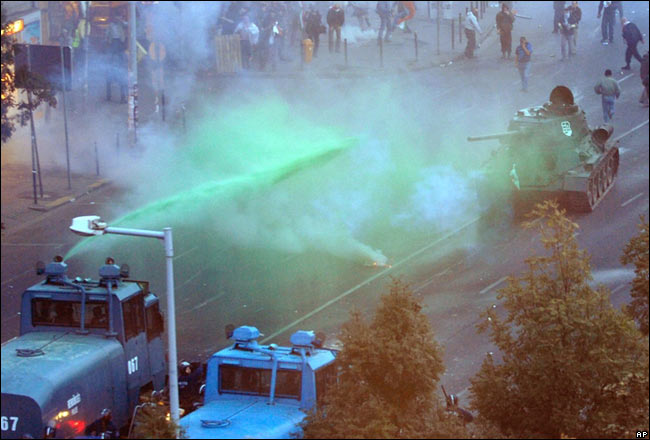
Hungary police tackle protesters
Hungarian police faced protesters in a Soviet-era tank Hungarian police are tackling the remnants of a group of violent protesters who disrupted celebrations marking the 1956 anti-Soviet uprising.
Tear gas and rubber bullets were used to quell anti-government protests in Budapest, where officials laid flowers to mark the uprising 50 years ago.
Some protesters commandeered a tank taken from an uprising exhibition. Read more at BBC here
Monday, October 23, 2006
Wild Kids - the far side of Council
Someone called Jake McPherson [jakemcpherson4456@hotmail.com] has taken the time to research my family name and send me this explanation via emails from the Australian Museum web site. He seems to think it's funny and so do I. Each day when I am called 'Duck' from preschool to today I think 'if only I had a dollar ...' . It's the name that has stuck and I'm quite fond of it. A former mayor used to refer to me as Councillor Fluffy Duck that inevitably was shortened to 'fluffy' to the confused looks of friends over post Council dinner. I even have a pretty good quality carved wooden hand painted Mallard in my Town Hall office on the shelf watching over me. Thanks Jake - it goes to show that not all correspondence is about parking police or garbage bins!
Wild kids

Mallards were introduced into Australia from the Northern Hemisphere and have been breeding with our native Pacific Black Duck.
Common name: Mallard Scientific name: Anas platyrhynchos Photo: A. Skates
Mallard
Mallards are ducks that live near ponds, lakes and dams on urban and rural land in south-eastern Australia. The males have a green head, yellow beak and chestnut coloured breast. The females are brown all over. They both have flat beaks with thin plates to sieve food particles out of the water. They have feet with three webbed toes and one very small back toe.
Mallards call with a loud quack.
 This is a male Mallard swimming with some ducklings.
Mallards look for small plants and animals in the water. They use their beak to feel around in the muddy bottom of ponds, lakes and dams for food. On land they look for seeds, flowers, food scraps and insects in the morning and late afternoon.
Mallards make nests from a scrape on the ground lined with a small amount of grass. The female lays eight to twelve glossy, light green eggs that she sits on for 26 to 28 days. When the eggs hatch the ducklings are covered in soft down. They follow their parents to water within a day of hatching and can swim as soon as they reach water. The ducklings can feed themselves shortly after hatching and have feathers and are ready to fly in seven to eight weeks.
Copyright © Australian Museum, 2003
Wild kids

Mallards were introduced into Australia from the Northern Hemisphere and have been breeding with our native Pacific Black Duck.
Common name: Mallard Scientific name: Anas platyrhynchos Photo: A. Skates
Mallard
Mallards are ducks that live near ponds, lakes and dams on urban and rural land in south-eastern Australia. The males have a green head, yellow beak and chestnut coloured breast. The females are brown all over. They both have flat beaks with thin plates to sieve food particles out of the water. They have feet with three webbed toes and one very small back toe.
Mallards call with a loud quack.
 This is a male Mallard swimming with some ducklings.
Mallards look for small plants and animals in the water. They use their beak to feel around in the muddy bottom of ponds, lakes and dams for food. On land they look for seeds, flowers, food scraps and insects in the morning and late afternoon.
Mallards make nests from a scrape on the ground lined with a small amount of grass. The female lays eight to twelve glossy, light green eggs that she sits on for 26 to 28 days. When the eggs hatch the ducklings are covered in soft down. They follow their parents to water within a day of hatching and can swim as soon as they reach water. The ducklings can feed themselves shortly after hatching and have feathers and are ready to fly in seven to eight weeks.
Copyright © Australian Museum, 2003
Thursday, October 12, 2006
Front page debate for Liberal Women
Federal Liberal Party President and a well known local Liberal party member, Chris McDiven has caused a stir in Canberra with her front page comments in today's Australian comparing Labor's first wives club to the Liberal party's successful election of female parliamentarians based only on merit. Read about it below. Chris and eCouncillor have traveled parallel political paths since the early 90's when Chris was President of the NSW Women's Council and I was President of the NSW Young Liberal Council. Subsequently Chris had several terms as the NSW State President and then to the Federal Presidency. Each position fought for in democratic ballots and won on hard work and merit. Chris has ruled out a parliamentary career after the repeated urgings of her supporters including eCouncillor.
The Australian
http://www.theaustralian.news.com.au/story/0,20867,20566215-2702,00.html
Top Lib mocks Labor's ex-wives club
Dennis Shanahan, Political editor
October 12, 2006
THE Liberal Party's first lady has taken a swipe at the Labor Party sisterhood, branding it an ex-wives' club that had got ahead by connections and embarrassing quotas.
The Liberal Party's federal president, Chris McDiven, has pulled no punches in her assessment of female Labor MPs as she prepares to celebrate Liberal women in cabinet.
"If you look at our women, they represent a wide selection of careers, career paths into parliament and a wide diversity of backgrounds, whereas if you look at the Labor women, you'll find that nearly everyone has got there through their family connections - they're 'wives of', 'ex-wives of', 'daughters of', 'sisters of'. It is an interesting comparison," Ms McDiven told The Australian yesterday.
Ms McDiven stepped into the media spotlight yesterday for the first time since she was elected 16 months ago as the Liberal Party's first female federal president.
A confessed "backroom girl" who has not sought election to parliament herself, the 58-year-old mother of two, former teacher, small businesswoman and investment manager also took pity on her ALP counterpart, NSW state MP Linda Burney, who is guaranteed a term as ALP president because of affirmative action.
Ms Burney ran last in the current four-way ALP presidency race - well behind former Labor leader Simon Crean - but will be given a turn as ALP president in 2009 while Mr Crean misses out.
"Personally I feel a bit sorry for Linda Burney," Ms McDiven said at the Liberal Party headquarters yesterday. "I feel much prouder that I have managed to get to this position on my merit. She's getting there, unfortunately for her, as a number on affirmative action. I don't think that will help her in the long term."
Ms McDiven, who ran a program training women candidates that is credited with doubling the number of women Liberal MPs at the 1996 election, said the Liberal way was to be elected on merit without quotas.
"Personally, if I had got myself into parliament because I was a 'number' I would not be completely satisfied with that," she said.
"I would like to think I got there on merit. Our women can hold their heads up and say they got there completely on merit."
Ms McDiven said many Labor MPs got into parliament on the back of family or marital connections but the Liberal Party was trying to encourage women to come forward and be elected on merit.
"When we set up the training program I learnt then that we had to go and find women; women tend not to put themselves forward," she said.
"We are seriously looking for women with talent to put themselves forward.
"I have spoken to Republican women in the US and the Conservative Party in the UK, they all say the same thing, men tend to put themselves forward."
Ms McDiven said she "got a buzz" when Julie Bishop was appointed as the first female Liberal cabinet minister from the House of Representatives and took pride in the record three women who were now in cabinet.
She said energetic new NSW senator Connie Fierravanti-Wells came through the Liberal program.
Ms McDiven said she did not believe gender had played a part in the contretemps in NSW over the state preselection battle for the high-profile Pru Goward.
She believed geographic reasons were important because the seat Ms Goward was now standing in, near Yass, was closer to where she lived.
Ms McDiven is attending a gala dinner tonight in Canberra to celebrate the record number of women in the Coalition cabinet.
Friday, September 22, 2006
Park the car and pedal
More from the City of Cyclists. Go to the link detailing Copenhagen's love affair with cycling and down load the great short film directed by my friend Michael Thomas.
Park it and pedal
A new concept uses rent-a-cycles to solve city commuters' parking problems
A car park firm has come up with an answer to Copenhagen's inner city parking problems, using the nation's cycling tradition as the solution's vehicle.
ParkCity, owner of Denmark's largest car park, has developed a concept called Park & Pedal, which hopes to put the city's less-congested car parks to good use.
'The concept is that drivers can park their cars in our lot at Israels Place, and then have a bicycle there reserved for them for an extra 100 per month,' said Frank Nielsen, ParkCity's manager.
Park & Pedal allows the customer to keep the cycle as long as he or she likes, and they can return it when picking up their car again.
Nielsen said that there are many open parking spots at the underground lots, but that some lie too far away from a person's workplace.
'If you park the car and still have a ways to go to work, you can just as well bike instead of walking or being a victim of the Metro's repeated delays. Bicycles are and will be the quickest, most flexible and, not least, most environmentally friendly means of transport in a big city like Copenhagen,' said Nielsen.
The new concept is only a week old, but is already becoming popular.
'For me it's the perfect solution,' said ParkCity customer Michael Lagoni. 'I live 40 to 50 kilometres away, and it nicely fits my needs that I can cycle the last bit from the car park to work.'
The Copenhagen Post
Park it and pedal
A new concept uses rent-a-cycles to solve city commuters' parking problems
A car park firm has come up with an answer to Copenhagen's inner city parking problems, using the nation's cycling tradition as the solution's vehicle.
ParkCity, owner of Denmark's largest car park, has developed a concept called Park & Pedal, which hopes to put the city's less-congested car parks to good use.
'The concept is that drivers can park their cars in our lot at Israels Place, and then have a bicycle there reserved for them for an extra 100 per month,' said Frank Nielsen, ParkCity's manager.
Park & Pedal allows the customer to keep the cycle as long as he or she likes, and they can return it when picking up their car again.
Nielsen said that there are many open parking spots at the underground lots, but that some lie too far away from a person's workplace.
'If you park the car and still have a ways to go to work, you can just as well bike instead of walking or being a victim of the Metro's repeated delays. Bicycles are and will be the quickest, most flexible and, not least, most environmentally friendly means of transport in a big city like Copenhagen,' said Nielsen.
The new concept is only a week old, but is already becoming popular.
'For me it's the perfect solution,' said ParkCity customer Michael Lagoni. 'I live 40 to 50 kilometres away, and it nicely fits my needs that I can cycle the last bit from the car park to work.'
The Copenhagen Post
Thursday, September 21, 2006
Clover Moore's glass jaw
This week's Council meeting has again highlighted the recurring flaw in Clover Moore's leadership style. eCouncillor readers will recall that the annual election of committee chairs, CSPC members (2) and the Deputy Lord Mayor as the ONLY time that the 10 Councilors each have an equal vote - that's real democracy. There is no casting or second vote for the Lord Mayor in the election process in stark comparison to her nightly exercise of her casting or second vote (arguably an undemocratic power) each time she can not get her way at the Council meeting.
Last year the Moore party lost the Deputy Lord Mayoral position to Labor's Councilor Verity Firth in a 5 all tied vote and a subsequent 'draw from the hat' (or wooden barrel actually) between Firth and Moore's candidate John McInerney. Fearing that she could not guarantee her people into the plush elected positions chairing the various Council committee (Finance, Planning, Cultural etc) Moore moved a sudden resolution to abolish the chair positions by seizing control of them for herself. This was reported by the Sydney Morning Herald as a sign of her inability to handle criticism (see below).
SMH September 2005
http://www.smh.com.au/news/national/moore-and-more/2005/09/16/1126750129200.html
Moore and more
September 17, 2005
Clover Moore's grip on the controls of the city just got tighter, so be careful not to get in her way, warn her colleagues. Tim Dick reports.
Some people thrive on criticism. Some are broken by it. Some just don't tolerate it - from friend or foe - and are prepared to cop the consequences of not hearing it.
This week, Sydney's Lord Mayor, Clover Moore, discovered the ramifications of what her opponents say are the main irritants of her mayoralty: over-sensitivity, exclusion and taking credit for everything the council does, her idea or not.
Her deputy, the planning expert John McInerney, was dumped from office after the Greens councillor Chris Harris withdrew his support. Without it, McInerney lost by lot, a blind draw from a wooden box, prompting Moore to use a procedural rule to seize all seven of the council's committee chairmanships.
After being criticised for wanting two jobs, member of Parliament and mayor, she now has 10, including chairing the Central Sydney Planning Committee, a government-controlled body which approves major development.
Harris and Moore, a community independent with a decidedly green tinge, should be firm bedfellows. But, after Moore's promise last year to work co-operatively and constructively with other Councilors, things have soured.
On Monday night Moore took her autocratic and undemocratic leadership style one step too far moving to in effect abolish the position of Deputy Lord Mayor since she could not accept a 50:50 democratic chance on the outcome. Opposition Councillors smelt a rat early on in the unprecedented reversal in the order of the elections with Council electing the Chair of Traffic Committee before dealing with the Deputy Lord Mayoral position. (see Election of Office Bearers for 2006/07 below)
http://www.cityofsydney.nsw.gov.au/Council/MeetingsAndCommittees/2006/Council/180906.asp
Opposition Councillors still contest the remnant Deputy Chairs of Committees that were ironically all won by Moore loyalists via a draw from the hat. But when Clover Moore pounced with a motion to not elect a Deputy Lord Mayor of Sydney the opposition Councillors were outraged. We may have let her seize control of Committee chairmanships last year with a loud grumble and again this year but to abolish a position that is as old as the Council itself and that exists in all other Councils across Australia was going too far. In riding rough shod over the democratic election of the deputy position by the Councillors, Clover Moore and her advisors had taken their arrogance in power one step too far. How on earth they did not foresee our genuine outrage is very hard to comprehend. One after the other the 5 opposition Councillors rose in anger speaking out in outrage against the insult to the Council and the people of Sydney. Moore party Councillors rubbed their hands together claiming the position was redundant and an historical anomaly! It wasn't when Councilor McInerney held onto it for the first 15 months nor when he ran last year to be defeated by Firth.
In speaking on a point of order against the proposal to abolish the post I made the point that it was not as though a non Moore party Deputy Lord Mayor had been a fly in the ointment for Clover Moore and the City. In fact Labor's Councilor Firth had proved herself a co-operative and an effective Deputy and generally sang from the same song sheet as Moore. But this was different - this was not going to be one of the sisterhood, it was Greens Councilor Chris Harris, her opponent in Bligh/Sydney seat at the coming election and the 'Judas' of her Lord Mayoralty (her description). Harris has been running an effective gorilla (no pun intended there Chris - should be guerilla) campaign against Moore in her electorate and she feared his win would elevate his campaign status even further as well as quadruple his resources. I can see her concern with her double salaries and more the 1700 staff compared to Harris' 4 staff and $27,000 as a Councilor. With the two jobs (Lord Mayor and MP) issue still biting in the thoughts of the electorate, Harris' election to DLM would further erode her greenish voter base.
The opposition Councillors exercised their only other real power and walked out of the meeting to deny Moore a quorum and force her to conduct a democratic ballot. Moore seemed genuinely stunned as we left the Council chamber filing past an applauding and angry public gallery. The Local Government Act gives Council 30 minutes to reconvene. Failing to do so the chair sets a new date and time to continue the meeting. 15 minutes into our protest the Moore party Councilor Robyn Kemmis (who we elected earlier unopposed as the Deputy Chair of Finance Committee) called down to the opposition offices requesting our return and announcing that Clover Moore was withdrawing her motion to abolish the position of Deputy Lord Mayor. We returned and after a typical spin laced lecture from Moore we proceeded to the ballot. The draw from the hat delivered Councilor Chris Harris. That's karma for you Clover!!
In other related news - I was elected unopposed and unanimously to the powerful Central Sydney Planning Committee (details below) having forced my way onto the CSPC last year against Moore's wishes and using the draw from the hat method it seems I have earnt my place there. That goes to show that Moore's paranoia about sharing power says more about her psychology than the reality.
Election of CSPC Members
http://www.cityofsydney.nsw.gov.au/Council/documents/meetings/2006/Council/180906/18-09-06_COUNCIL_ITEM4.1.pdf
ITEM 4.1 CENTRAL SYDNEY PLANNING COMMITTEE - ELECTION OF MEMBERS
FILE NO: S031913
MEMORANDUM BY THE CHIEF EXECUTIVE OFFICER
To Council:
The Central Sydney Planning Committee (CSPC) is constituted by the City of Sydney Act 1988.
Section 34(1) of the Act provides that the Committee shall consist of seven members:
(a) the Lord Mayor of Sydney;
(b) a senior government employee with architectural experience nominated by the Minister administering the Public Works Act 1912;
(c) 2 Councillors of the City of Sydney elected by the City Council;
(d) the Director of Planning under the Planning Act; and
(e) 2 persons appointed by the Minister administering Part 4 of the Planning Act.
The person appointed pursuant to Clause (b) is Mr Peter Mould, NSW Government Architect, Department of Commerce.
The two persons appointed by the Minister pursuant to clause (e) are Ms Antoinette le Marchant and Mr Neil Bird.
Previously, the Council has chosen to hold a separate election for each of the two positions and the elections were by open, exhaustive voting.
At the Council meeting of 12 September 2005, Council elected Councilor John McInerney and Councilor Shayne Mallard to the two positions on the CSPC for terms ending on 30 September 2006.
In the following day's media Moore's spin city was decrying the undemocratic 'draw from the hat' and making the extraordinary claim that she should be able to appoint who she wants as deputy because that method is MORE democratic. Get that logic? it seemed Ok when she is winning the positions. But with 43% of the primary vote at the Council election there is a case to be made that the leadership of the Council should be more proportional. Clover Moore's constant use of a second or casting vote dozens of times to ram through her party's agenda could also be described as undemocratic using her logic.
http://www.smh.com.au/news/national/deputy-draw-creates-problem-for-moore/2006/09/18/1158431650398.html
Deputy draw creates problem for Moore
Bellinda KontominasSeptember 19, 2006
CLOVER MOORE'S hopes of choosing her deputy as Lord Mayor of Sydney have been dashed after a dramatic walk-out at a council meeting last night.
All but the independent Councilors walked out in protest over Ms Moore's decision not draw the deputy's name out of a hat, but they were soon called back in and the name of the Greens councillor Chris Harris was drawn.
Under the Local Government Act a council may elect a deputy mayor but is not required to. Cr Moore said the State Government should change the law.
"It is ridiculous in this day and age that Sydney's deputy lord mayor needs to be appointed through a draw from a hat." The appointment of Cr Harris, who has said he will stand for Cr Moore's state seat in March, is a serious blow to her.
She said backroom deals had been done by Labor, the Liberals and the Greens to place in the role someone more concerned with state politics than the council.
She said it could subvert her work for the city. "I don't think [this process] is the proper use of public money.
"Relying on the luck of the draw is undemocratic and until the State Government sees fit to amend the legislation I will continue to delegate duties to Councilors based on their skill, interest and availability."
Cr Moore, who has been criticised for her autocratic management style, said it was her right as Lord Mayor to choose her deputy.
"I describe my style as inclusive and non-adversarial. I'm here to serve the city and I expect all parties to do the same," she said. Cr Harris could not be reached for comment last night.
The name-from-a-hat option is as old as democracy itself. Probably older than the casting vote. Rather than undemocratic as Moore claims, it is believed to have evolved as a civilised way to resolve ballot ties as opposed to bribery or duels. In recent years the draw from a hat method has been proposed to resolve the ALP leadership ballot and it even has constitutional precedent in Victoria where, in a tied 1985 Victorian Upper House election, a returning officer drew the winner from a hat between two candidates.
In a footnote Clover Moore's outrageous actions and the spin her million dollar PR machine put on it have been seen through by many commentators and bloggers. Whilst the mainstream media handled the matter with kid gloves - no doubt finally anthesised by Clover Moore's outrageous advertising spend and huge spin budget- the internet remains beyond her manipulation.
Here's two good blog posts on the shenanigans.
http://kingscrosstimes.blogspot.com/
http://www.southsearepublic.org/story/2006/9/19/81435/9543
and all this deserves a revisit of the popular eCouncillor Queen Clover post.
http://ecouncillor.blogspot.com/2006/05/satirical-look-at-citys-administration.html
Tuesday, September 19, 2006
Cyclocity in Brussels - Sydney soon?
I received an email this morning from Steve Connor the CEO of JCDecaux Australia informing me of their exciting Cyclocity bicycle hire service launched during car free day in Brussels. I met Steve at the Cycling Promotion Fund 'Business of Cycling Breakfast' earlier this week. It was a great event with the broad range of cycling proponents in attendance including the head of bicycle Police unit, bike importers, retailers, sporting and tourist operators, health experts and government. Councillor John McInerney gave an address on the new City of Sydney draft bike plan www.cityofsydney.nsw.gov.au
As we roll out more cycling infrastructure across the City of Sydney it will be exciting to offer a bicycle hire service for residents, workers and tourists of this quality in Sydney.
Media Release below and read about Cyclocity here and images..
JCDecaux launches Cyclocity® in Brussels
on the city’s ‘car-free day’
Paris, September 18, 2006 – JCDecaux (Euronext Paris: DEC), the number
one outdoor advertising company in Europe and in the Asia-Pacific region,
and number two worldwide, yesterday launched Cyclocity® in Brussels on the
city’s annual ‘car-free day’. With 250 self-service bicycles available at
23 cycle racks, this innovative system is now up and running within the
pentagon of boulevards surrounding central Brussels.
Following Vienna (Austria), Cordoba and Gijon (Spain), Brussels becomes
the 4th city outside France to team up with JCDecaux, the world leader in selfservice
bicycle hire, and offer this pioneering form of individual public
transport.
In France, Cyclocity® (christened Vélo’v® by the greater Lyons area), has
enjoyed unprecedented success since its début in Lyons in May 2005. The
system’s 60,000 subscribers – who hire bicycles up to 28,000 times per day –
have already covered 10 million kilometers in the space of 15 months,
averaging a daily total of 40,000 kilometers - equal to the circumference of
the Earth at the equator..
According to a BVA survey carried out in May 2006, Vélo’v® users are
extremely satisfied with the service, giving it an average score of 7.7 out of
10. Acting as veritable ambassadors for the service, they contribute to its
continued development through favourable word-of-mouth publicity. Indeed,
Vélo’v® enjoys a personal recommendation rate of almost 90%.
Brussels will now become a new showcase for Cyclocity for cities wanting to
adopt this new type of eco-friendly transport system.
Commenting on the launch of Cyclocity® in Brussels, Jean-Charles Decaux,
Chairman of the Executive Board and co-CEO of JCDecaux, said: “With
Cyclocity, JCDecaux is introducing its pioneering means of individual public
transport for the first time in Belgium. This is why we decided, in agreement
with the City of Brussels, to launch this system on the highly symbolic
occasion of ‘car-free day’..
“In line with the expectations currently expressed by cities and citizens in
terms of sustainable development, Cyclocity® forms an integral part of the
urban landscape as an eco-friendly answer to the problems of excessive car
use and pollution while simultaneously guaranteeing safety, comfort and ease
of use. With its development constantly driven by innovation, JCDecaux is
demonstrating once again, with Cyclocity®, its ability to offer local
communities new solutions capable of meeting the challenges confronting
them, notably in the area of environmental protection”.
Key Figures for the JCDecaux Group:
- 2005 revenues: €1,745.2m, first half 2006 revenues: €945.8M
- JCDecaux is listed on the Eurolist of the Euronext Paris stock exchange, and is part of
the Euronext 100 and FTSE4Good indices.
- N°1 worldwide in street furniture (318,000 advertising panels)
- N°1 worldwide in airport advertising with 153 airports and more than 300 transport
contracts in metros, buses, tramways and trains (207,000 advertising panels)
- N°1 in Europe for billboards (200,000 advertising panels)
- N°1 in outdoor advertising in China (79,000 advertising panels in 20 different cities)
- 725,000 advertising panels in 48 countries
- Present in over 3,400 cities with over 10,000 inhabitants
- 7,900 employees
As we roll out more cycling infrastructure across the City of Sydney it will be exciting to offer a bicycle hire service for residents, workers and tourists of this quality in Sydney.
Media Release below and read about Cyclocity here and images..
JCDecaux launches Cyclocity® in Brussels
on the city’s ‘car-free day’
Paris, September 18, 2006 – JCDecaux (Euronext Paris: DEC), the number
one outdoor advertising company in Europe and in the Asia-Pacific region,
and number two worldwide, yesterday launched Cyclocity® in Brussels on the
city’s annual ‘car-free day’. With 250 self-service bicycles available at
23 cycle racks, this innovative system is now up and running within the
pentagon of boulevards surrounding central Brussels.
Following Vienna (Austria), Cordoba and Gijon (Spain), Brussels becomes
the 4th city outside France to team up with JCDecaux, the world leader in selfservice
bicycle hire, and offer this pioneering form of individual public
transport.
In France, Cyclocity® (christened Vélo’v® by the greater Lyons area), has
enjoyed unprecedented success since its début in Lyons in May 2005. The
system’s 60,000 subscribers – who hire bicycles up to 28,000 times per day –
have already covered 10 million kilometers in the space of 15 months,
averaging a daily total of 40,000 kilometers - equal to the circumference of
the Earth at the equator..
According to a BVA survey carried out in May 2006, Vélo’v® users are
extremely satisfied with the service, giving it an average score of 7.7 out of
10. Acting as veritable ambassadors for the service, they contribute to its
continued development through favourable word-of-mouth publicity. Indeed,
Vélo’v® enjoys a personal recommendation rate of almost 90%.
Brussels will now become a new showcase for Cyclocity for cities wanting to
adopt this new type of eco-friendly transport system.
Commenting on the launch of Cyclocity® in Brussels, Jean-Charles Decaux,
Chairman of the Executive Board and co-CEO of JCDecaux, said: “With
Cyclocity, JCDecaux is introducing its pioneering means of individual public
transport for the first time in Belgium. This is why we decided, in agreement
with the City of Brussels, to launch this system on the highly symbolic
occasion of ‘car-free day’..
“In line with the expectations currently expressed by cities and citizens in
terms of sustainable development, Cyclocity® forms an integral part of the
urban landscape as an eco-friendly answer to the problems of excessive car
use and pollution while simultaneously guaranteeing safety, comfort and ease
of use. With its development constantly driven by innovation, JCDecaux is
demonstrating once again, with Cyclocity®, its ability to offer local
communities new solutions capable of meeting the challenges confronting
them, notably in the area of environmental protection”.
Key Figures for the JCDecaux Group:
- 2005 revenues: €1,745.2m, first half 2006 revenues: €945.8M
- JCDecaux is listed on the Eurolist of the Euronext Paris stock exchange, and is part of
the Euronext 100 and FTSE4Good indices.
- N°1 worldwide in street furniture (318,000 advertising panels)
- N°1 worldwide in airport advertising with 153 airports and more than 300 transport
contracts in metros, buses, tramways and trains (207,000 advertising panels)
- N°1 in Europe for billboards (200,000 advertising panels)
- N°1 in outdoor advertising in China (79,000 advertising panels in 20 different cities)
- 725,000 advertising panels in 48 countries
- Present in over 3,400 cities with over 10,000 inhabitants
- 7,900 employees
Thursday, September 14, 2006
Helmeted riders 'more likely to be hit'
Helmeted riders more likely to be hit by a car!!
By Tamara McLean, National Medical Writer
September 14, 2006 02:05pm
Article from: AAP
CYCLISTS who wear helmets for better protection on the road are ironically more at risk of being knocked down by cars, according to new research.
A study by a British traffic psychologist has found that drivers pass twice as close when overtaking cyclists wearing helmets than when overtaking their bare-headed counterparts.
Drivers shaved an average of 8.5cm off their passing distance when passing cyclists wearing helmets, increasing the risk of a collision.
"This study shows that when drivers overtake a cyclist, the margin for error they leave is affected by the cyclist's appearance," said Dr Ian Walker, from the University of Bath.
"By leaving the cyclist less room, drivers reduce the safety margin that cyclists need to deal with obstacles in the road, such as drain covers and potholes, as well as the margin for error in their own judgments."
The scientist used a bicycle fitted with a computer and an ultrasonic distance sensor to record data from over 2500 overtaking motorists in Salisbury and Bristol.
Dr Walker spent half the time wearing a cycle helmet and half without and was knocked down twice, by a bus and a truck, while helmeted.
He said while helmets had been proven to protect kids in low speed falls, it was questionable whether they offered any real protection to somebody struck by a car.
"Either way, this study suggests wearing a helmet might make a collision more likely in the first place," Dr Walker said.
He believed drivers perceive cyclists as an unfamiliar sub-culture of "lycra-clad street-warriors".
Riders wearing helmets were incorrectly viewed as very experienced and less likely to do something unexpected, which explains why drivers leave less space when passing.
To test another theory, Dr Walker donned a long wig to test whether there was any difference in passing distances when drivers thought they were overtaking a female cyclist.
He said drivers gave "her" an average of 14cm more space than for a man not wearing a helmet, probably because women riders were seen as more unpredictable.
The study, accepted for publication in the journal, Accident Analysis & Prevention, also found that buses and trucks passed considerably closer than cars.
There are some academics who argue that by removing the compulsion to wear helmets when riding bicycles the resultant increase in people taking up riding their bikes (particularly to work) would result in a net community health benefit through decreased obesity, heart disease, diabetes and mental health disorders after the additional head traumas are taken into account. Council's own research has shown that in the top 5 reasons why people do not ride a bicycle to work is the requirement to wear a helmet with some finding them 'unattractive' and others concerned about the impact upon their hair style. Of course safety was the first reason why people did not take up riding - a rather contradictory outcome. I do not know of any government that has reversed a road safety regulation.
Thursday, September 07, 2006
Best justice that money can buy
Crikey.com.au makes a sharp point today on the relative inequality of our justice system, comparing Steve Vizard's case to the case of a young Aboriginal burglar caught doing over Vizard's Toorak mansion.
The inequality of Australian justice was on full display in Melbourne yesterday.
On one side of William Street, in a witness box inside the Supreme Court, a wealthy, handsomely-suited, prosperous-looking 50-year-old businessman was into his third day of refusing to answer questions about, among other things, his illicit share dealings. On the other side of the street, in the dock inside the County Court, a remorseful 21-year-old Aboriginal burglar with a history of drug addiction and 75 previous convictions was being sentenced to four years' jail after pleading guilty to 25 counts of theft and burglary.
Steve Vizard squirmed but, advised by a legal team that included two of Australia's most expensive QCs, he managed to avoid giving evidence that could expose him to prosecution for perjury or for trading shares while on the board of Australia's biggest company, Telstra -- offences for which he was tapped over the knuckles by ASIC, fined $390,000 and disqualified from being a company director for ten years.
In the courtroom over the road, Peter Clarke also squirmed. "I'm very, very sorry for the pain I have caused in committing these crimes," he told the judge -- crimes which included aggravated burglary and stealing six laptop computers from the Toorak mansion of Steve Vizard.
As Steve Vizard could affirm, if he was prepared to answer, Australian justice is still the best that money can buy.
Tuesday, September 05, 2006
Euro-style bike lanes plan for City
If it's good enough for Melbourne's cyclists then why not Sydney? As I have continually advocated for the 'Gateways' and Kent Street routes.
from the Sunday Age....
Coming this way: a Copenhagen cyclist passes a row of parked cars keeping him segregated from moving traffic.
Photo: Casual Cas
http://www.theage.com.au/news/national/eurostyle-bike-lanes-plan-for-city/2006/09/02/1156817151269.html
Clay Lucas September 3, 2006
 MELBOURNE is to get its first taste of European-style bike lanes that separate cyclists and car traffic by putting a parking lane between them.
The bike lanes, which will run along either side of Swanston Street from Melbourne University to RMIT, will cost more than $500,000.
If the trial is successful, VicRoads will consider rolling out more of the bike lanes across the city.
The new-style lanes will be two metres wide and 50 centimetres lower that the footpath.
Under the design, named the Copenhagen Treatment by planners because it is common in that city, existing numbers of parking spots will be kept but moved away from the footpath and towards the middle of the street.
Work on the scheme, aimed at reducing the number of cyclists being hit by cars on that stretch of road, is set to start at the end of the year.
The area has become a bicycle black spot, with six cyclists admitted to hospital after being knocked off their bikes in the past five years.
Under the City of Melbourne's cycling strategy released last week, installation of similar lanes on main cycling roads across the city is likely.
"This is the next stage of this city's bicycle lanes," said Harry Barber from Bicycle Victoria, which has worked closely with the council and VicRoads to get support for the new lanes.
"Drawing a line to mark out a bike lane came first, over the last decade. Then they started painting bicycle lanes green, as we're seeing all over town," Mr Barber said.
"Now they've reached the next stage: separating bikes and cars physically. Australians all have bikes, and they love riding them, but most are reluctant to ride in traffic. These lanes will mean they don't have to."
On average, 1000 cyclists a year are admitted to hospital after accidents. Some 200 end up in hospital after a collision with a car. On main cycling strips such as St Kilda Road, which has boomed as a cycling area since bike lanes were created in 1993, the number of cyclists in accidents with cars has stayed steady.
Wednesday, August 30, 2006
City to put Rangers on Bicycles
 MEDIA RELEASE
City to put Rangers on Bicycles
Liberal City of Sydney Councillor Shayne Mallard has called upon the Council to introduce bicycle based City Rangers to patrol the CBD and inner city.
Noting that the NSW Police have regularly patrolled the streets on bicycles since the 2000 Olympics, Councillor Mallard asked the Lord Mayor at tonight's meeting to introduce bicycle transport for the City's Rangers.
" Bicycle Police patrols are a welcome sight on our city streets ," Shayne Mallard said.
"City Rangers riding bicycles attending to their duties in parking enforcement and patrolling our open spaces would be a more civic minded way to interact with our community members."
The City currently employs Rangers located in the CBD and at various One-Stop-Shops around the inner city.
"Bicycle based Rangers would also help to activate our emerging bicycle networks and lanes, assisting with education and enforcing responsible behaviour from cyclists and other road users."
Shayne Mallard's proposal was supported by the Lord Mayor.
Shayne noted that there would be no compulsion for existing staff to 'get on their bike' but that a training program, bikes, clothing and equipment would be introduced to volunteers and new staff recruited over time.
"Introducing bicycle Rangers will assist in the physical and mental well being of our staff with the health benefits of cycling well documented."
"Bicycle Rangers will also help reduce our organisation's contribution to traffic and parking congestion as well as be a positive contributor to the environment."
Councillor Shayne Mallard who is a keen cyclist himself looks forward to the success and possible expansion of this initiative to other areas of the Council's 2000 staff.
RELEASE ENDS
28 August 2006
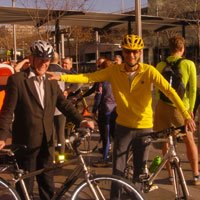
(pictured - Councillors John McInerney and Shayne Mallard at the recent Ride to Work awards breakfast.)
Monday, August 28, 2006
Apology for Insult at the Cenotaph
eCouncillor readers would remember my post on representing the City of Sydney at the VP Day memorial service at the Cenotaph, Martin Place. It was a moving ceremony and a great honour.
Read the post here.
Imagine my anger at opening today's newspapers to see what I feel is a desecration of this sacred place. I visited Martin Place yesterday but the offensive display (in the name of art?) that greeted us on page 5 of today's Sydney Morning Herald had been removed by that time. Just as well with dozens of Vietnam diggers wandering through the Cenotaph attending a reception at government House in their honour. I think it was a pretty appalling oversight by our organisation to let this desecration occur. When I saw it in the SMH I was very angry and disappointed that we had been so insensitive, so careless. I know some will feel that all the victims of war have a right to be acknowledged. Body bags around the Cenotaph is an insult to the respectful memorial of all who die in wars. The impact upon returned service men and women, their families and those who did not return must be paramount in our thinking about uses for the Cenotaph.
The new CEO's report to Councillors is below along with the article form today' SMH. The picture is at the link (Blogger is getting very difficult to upload images).
Bags of controversy over cenotaph display
Stark ... Omeima Sukkarieh, the artist responsible for the display, said she had not intended it to be near the Cenotaph, a placement that has angered the RSL.Photo: Dean Sewell
Jordan Baker and David HumphriesAugust 28, 2006
THE City of Sydney has come under attack from the Returned and Services League for allowing hundreds of mock body bags - including one labelled "your prime minister" - to surround the Cenotaph in Martin Place.
The artist, Omeima Sukkarieh, said the display was supposed to be a stark reminder of innocent lives lost in war. That it surrounded a monument to real soldiers who were killed in war was an accident.
"Honestly, I really wanted to have it either at Circular Quay or Hyde Park," she said. "It was never intended to be Martin Place. It was just the only place available."
Sukkarieh said she had complied with the City of Sydney Council's protocols. "It was never meant to cause any disrespect, and if it did I apologise," she said.
The national president of the Returned and Services League, Bill Crews, said he would have been offended if Sukkarieh had staged a political protest beside the memorial to make a point. But in this case, the council should have been more careful.
"I take [the artist's] assurance that they didn't deliberately do it at the Cenotaph, but in that case the onus comes on the council for agreeing [to let it be] adjacent to the cenotaph," he said.
The body bags each had an identity meant to shock, such as "your daughter", "your prime minister" or "your doctor".
Sukkarieh said the display was intended to draw attention to the victims of war, particularly those killed in recent conflicts in Iraq, Afghanistan and Lebanon.
"There were some people who were not impressed and found it disgusting," Sukkarieh said. "But what's going on is disgusting. I respected everyone's opinions. It just made people think."
The body bag labelled "your prime minister" was not supposed to refer to John Howard but to a generic prime minister, she said.
"One had an ambulance officer, a journalist, a doctor. Death doesn't discriminate against people, and I think it's really about us realising as human beings that, prime minister or no prime minister, we are all the same."
The council was unable to comment last night.
The Minister for Veterans Affairs, Bruce Billson, said this "graphic demonstration" showed "a lack of respect for our service men and women who have given their lives".
"This could be quite traumatic for those who lost loved ones in conflicts while serving our country," Mr Billson said.
He said there were many alternative sites that would have been "more thoughtful and sensitive", and Martin Place was "totally inappropriate".
Lord Mayor & Councillors
I refer to the article on p.5 of today's Sydney Morning Herald regarding the display by Omeina Sukkarieh which used the Cenotoph as a backdrop.
I have written to the State President of the RSL (Don Rowe) to apologise for any offence or disrespect that this may have caused. I have also verbally apologised to the State Secretary of the RSL, Chris Perrin, who is also Custodian of the Cenotopaph.
The City receives many applications for use of Martin Place around the Cenotaph, and such applications are rarely approved (with the exception of events organised by the RSL). In the very few instances where approval is contemplated the City always consults with and seeks endorsement from the Custodian of the Cenotaph, Chris Perrin, who is also the NSW State Secretary of the RSL.
In this case the applicant was verbally advised that the display was to have been in the area between Castlereagh and Pitt Streets, not near or around the Cenotaph. Unfortunately the written approval provided to the applicant did not make this clear.
I have spoken with the staff involved and asked that procedures be reviewed to ensure that this does not occur again.
Monica Barone
Chief Executive Officer
Friday, August 18, 2006
Harmony script
Harmony Park has been well received by the Sydney Chinese community and park locals. Council is to install an interpretative feature to illustrate the meaning of the name. Any eCouncillor readers with suggestions are welcome to email me. Some suggestions include a sculpture or mosaic.


Mallard launches Cycle Strategy...
From Council's internal newsletter:
 Cycling in the City Program a huge success
Participants in the City’s Cycling in the City program were recognised at a cycling breakfast at Customs House this week.
More than 30 representatives of the ten government and corporate organisations that took part in the program attended the event, with most arriving by bike.
Councillor Shayne Mallard, himself a keen cyclist, presented certificates to the organisations and also launched the City’s 10-year cycle strategy, which is currently on public exhibition.
More than 100 cyclists have cycled more than 31,000kms on their journeys to work over the 12-week program, which provides peer support to help more people ride their bicycles to work on a regular basis. Participating organizations included ANZ, Westpac, the Australian Taxation Office and City of Sydney.
This stage of the Cycling in the City program has been a huge success, with more than 95 per cent of the participating cyclists indicating they will continue to ride to work and all ten organisations committing to supporting their cyclists in the future.
Major bike groups also attended the event to extend their thanks to the fledgling cyclists, who also received a free breakfast.
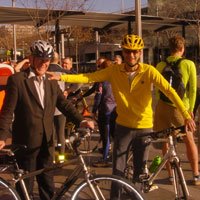
Pictured above are Councillors John McInerney (left) and Shayne Mallard at the awards presentation.
 Cycling in the City Program a huge success
 Participants in the City’s Cycling in the City program were recognised at a cycling breakfast at Customs House this week.
More than 30 representatives of the ten government and corporate organisations that took part in the program attended the event, with most arriving by bike.
Councillor Shayne Mallard, himself a keen cyclist, presented certificates to the organisations and also launched the City’s 10-year cycle strategy, which is currently on public exhibition.
More than 100 cyclists have cycled more than 31,000kms on their journeys to work over the 12-week program, which provides peer support to help more people ride their bicycles to work on a regular basis. Participating organizations included ANZ, Westpac, the Australian Taxation Office and City of Sydney.
This stage of the Cycling in the City program has been a huge success, with more than 95 per cent of the participating cyclists indicating they will continue to ride to work and all ten organisations committing to supporting their cyclists in the future.
Major bike groups also attended the event to extend their thanks to the fledgling cyclists, who also received a free breakfast.
Pictured above are Councillors John McInerney (left) and Shayne Mallard at the awards presentation.
Subscribe to:
Posts (Atom)